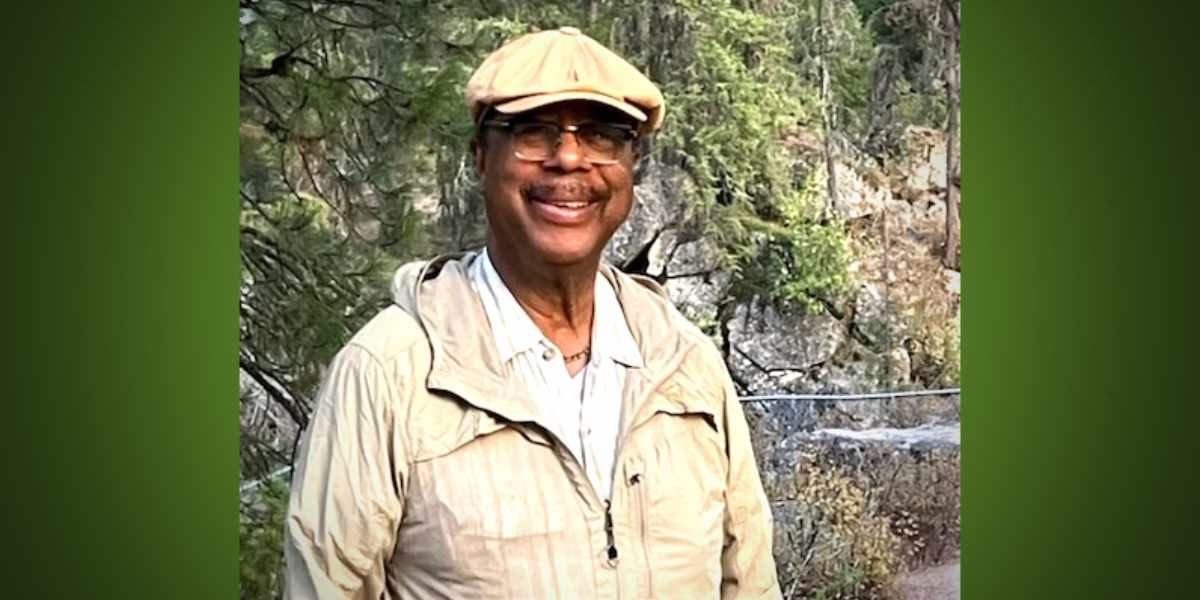
On Monday (Mar. 1st), Seattle Times columnist Jerry Large published a followup article that is basically a reaction to him being confronted by Burien Mayor Joan McGilton, Councilmember Kathy Keene and City Manager Mike Martin over Burien’s desire to annex the remaining portions of White Center.
The encounter came after Large published a column on Feb. 3rd extolling how White Center is “the right fit” for Seattle.
Councilmember Keene then sent us a copy of a letter she sent The Times, where she strongly refuted Large and claimed that Burien would be a better fit for White Center (read Keene’s letter here).
In Large’s latest column, he starts out by saying:
Burien is getting feisty.
The small city is not counting itself out as a home to the northern neighborhoods of North Highline.
So now, “feisty” Burien has struck back, and the columnist has printed our cityfolk’s claims, stating that “Burien knows what it wants” – read his full column here.
We wonder what will happen next in this political opinion-shaping chess match…stay tuned.
War Correspondent/Writer/Blogger Michael Yon claims via his Facebook Fan Page that he was detained at Sea-Tac Airport Tuesday morning (Jan. 5th) for “refusing to say how much money I make.”
Yon apparently is an ex-Green Beret turned war correspondent who’s covered wars in Iraq and Afghanistan. Obviously a well-traveled guy with combat experience, it’ll be interesting to hear the “other side” from TSA (if we ever do that is).
Here’s a screenshot of his Facebook posting:
And here’s the actual text of his post:
Got arrested at the Seattle airport for refusing to say how much money I make. (The uniformed ones say I was not “arrested”, but they definitely handcuffed me.) Their videos and audios should show that I was polite, but simply refused questions that had nothing to do with national security. Port authority police…eventually came — they were professionals — and rescued me from the border bullies.
Our guess is that trying to get through TSA with a Passport that has stamps from Iraq and Afghanistan, then refusing to answer questions = p.o.’d rent-a-cop types who are on edge after the Christmas Day bombing attempt…
Danielle Burton is an Artist who recently relocated to Burien from Bellingham, where she attained a degree in Illustration and Creative Writing from Western Washington University.
Danielle will be roaming around B-Town, creating illustrations, comics and stories for us (and oftentimes a combination of all three), and today we’re proud to introduce her first work, which is her take on how the Burien Interim Art Space’s “The Passage” sculpture will be leaving soon:


Author Neil Low and Friends celebrate the recent release of his second novel, Sign of the Dragon (Tigress Publishing, Sept 2009) at Burien’s hottest wine bar, BTB Advertiser Vino Bello, located at 626 SW 152nd Street, in downtown Burien.
Come on in for drink specials, beautiful women and well-told tales until 8:30pm tonight (Fri. Sept. 11th), and be sure to tell ‘em you “saw it on the blog.”
And if you want to get all high-tech and social, follow them on Twitter right now (just tell ‘em @btownblog sent ya):
| Sep ’09 |
| 11 |
| 5:30 pm |
BTB Advertiser Vino Bello is holding a special Book Signing & Wine Tasting on Friday, Sept. 11th from 5:30pm to 8:30pm with Author Neil Low, who will be signing his new book “Sign of the Dragon.”
Neil Low is a captain with the Seattle Police Department and the agency’s first commander of its new Ethics and Professional Responsibility Section. Other areas he has commanded include: Homicide and Violent Crimes, Internal Affairs, and Domestic Violence and Sexual Assault. He is a Vietnam veteran and a cum laude graduate of the University of Washington’s Bothell campus, where he also wrote for the school’s weekly newspaper, The UW Bothell Commons. A Seattle native, he now lives in Everett with his wife and three daughters.

Author Neil Low is a Captain for the Seattle Police Dept.
Here’s a synopsis of “Sign of the Dragon”:
1940 – The eve of WWII. Imperial Japan threatens to conquer Asia and the entire Pacific Theatre. Supplies and support are flowing into the region. Vital to this effort is the city of Seattle. But now, its crucial role in the supply chain is beginning to attract the interest of some shadowy and exotic international forces… Following a tip from his mentor Vic Morrison, young Alan Stewart uses his detective skills to track down Tiger Lee, a sexy American operative on a mission to disrupt the Japanese spy network. Working together, the two set out to eliminate the head of their Japanese rivals: a dangerous samurai whose movements are shrouded in mystery. What begins as a hunt for justice quickly turns into a maelstrom of revenge—and a race against the clock as politics becomes personal and loyalties are tested from every side. Returning to the scene of his first novel, Thick as Thieves, author Neil Low, proves once again that in the shadowy underbelly of a city nothing is as it first appears, and what you don’t know just might hurt you after all….
Here’s a review:
“Here’s the first thing I can tell you about Neil Low’s new novel: There are strong women herein. If you don’t like strong women or stories about them, find another book. The mood of this tale reminds me of the foggy, black and white crime movies of the period before World War II, and that’s not accidental. It’s clear that the author has extensively researched the Seattle of that era and makes that time real to his readers with deft, subtle touches. This story may humor you, and it’s likely to get your juices flowing. But perhaps most importantly, it’s going to make you think, because it has more twists and turns than the catacombs under Chinatown, which Low describes so vividly. And here is something else I can tell you: You will have to wonder if Low’s catacombs are real or if they are stuff of legend and myth. “Ay, there’s the rub,” as someone else who knew a thing or two about telling a good story once wrote.” –Lowen Clausen Author of The River, and First Avenue.
For more information on Neil Low, check out his website here.
Vino Bello is located at 636 SW 152nd St – F in Burien; (206) 244-VINO. For more information, check out their website here.
New York Times best-selling author Robert Dugoni held a book-signing at Burien’s Tin Room Wednesday night, with around 100 fans packed in for a meet and greet and autograph session from the writer of “Wrongful Death,” a suspense novel with many scenes set in this area, including The Tin Room.
Here’s a slideshow from Photographer Michael Brunk:
To read more of our coverage of Dugoni’s latest book and the scenes set in the Burien area, including a video, click here.
| May ’09 |
| 6 |
| 6:00 pm |

That’s New York Times best-selling Author Robert Dugoni above on the left, along with Burien businessman Dan House, right. Dugoni has incorporated the Burien area into his latest novel, “Wrongful Death,” including this pivotal scene set in House’s The Tin Room:

Dugoni will be celebrating his creative ties to Burien with a reading and book-signing party at The Tin Room at 6pm on Wednesday, May 6th.
We recently caught up with Dugoni, along with longtime Burien resident and businessman Dan House (aka “Dan the Sausageman,” and yes, his name was purposely misspelled in the book as “Hause”), and spoke with both about Burien, writing, and the importance of using authentic locations in a story.
House asked Dugoni why he chose to set the novel’s main character David Sloane’s home in Burien, and why he included The Tin Room.
“Burien is a very interesting place,” Dugoni said as he sipped an iced tea. “On one hand you’ve got this relatively remote, rich area with gorgeous views and beautiful waterfront homes, while just up and over the hill there are pockets of poverty. I just love the contrast, and the possibilities it allows for a mystery are tremendous.”

Author Robert Dugoni laughs as he unwraps his "teen idol" publicity poster.
Another reason Dugoni may have decided to include The Tin Room could be because it’s located next to House’s other retail business, “Dan the Sausageman.”
“One time I was driving through Burien and I saw this odd red neon sign that said ‘Dan the Sausage‘ and I just had to stop,” Dugoni laughed. “I parked, went inside and spoke with an older woman (Dan’s Mom Chirlee) who pointed out that the sign actually read ‘Sausageman‘ but because it was bent to go around a corner it looked like it only said ‘Dan the Sausage.’ I thought that was very unusual. Then I ate at The Tin Room and that was it.”
Dugoni, who makes his home in Kirkland, has family ties in Burien and often spends summer days down on the beach at Three Tree Point. This is his third novel, with the previous two being “The Jury Master” and “Damage Control.”
Here’s the synopsis for Wrongful Death, along with some early reviews:
Acclaimed attorney David Sloane (from the New York Times Bestseller, The Jury Master) agrees to take on a wrongful-death claim with a strong emotional tug. Beverly Ford, the widow of a national guardsman killed in Iraq is convinced her husband perished under nefarious circumstances. Sloane soon learns that established case law makes the prospect of victory over the federal government nearly impossible. When Sloane discovers that other members of Ford’s platoon have died under suspicious circumstances since returning to the U.S., he suspects a conspiracy to conceal the truth. In a battle for justice, Sloane must keep himself, and those he loves, from becoming the next casualties.
Mixing the suspense of a Grisham legal thriller with the political angle of a Baldacci. Dugoni is knocking on the A-list thriller door.
- BooklistPage-turning action…
- Publishers WeeklyAn entertaining thriller. Good guys to like, villains to hiss, windmills to attack.
- Kirkus
And here’s a publicity video produced for publisher Simon & Schuster that showcases some Burien areas – see if you can identify any:
Here’s Dugoni’s bio:
Robert Dugoni was born in Pocatello, Idaho and raised in Burlingame, California. Growing up the middle child in a family of ten siblings, Dugoni jokes that he didn’t get much of a chance to talk, so he wrote. By the seventh grade he knew he wanted to be a writer.
Dugoni wrote his way to Stanford University where he majored in communications/journalism and creative writing and worked as a reporter for the Stanford Daily. He graduated Phi Beta Kappa and worked briefly as a reporter in the Metro and San Gabriel Valley Offices of the Los Angeles Times before deciding to attend the UCLA law school. Dugoni practiced law full-time in San Francisco as a partner at the law firm, Gordon and Rees and is currently of counsel for a law firm in Seattle.
While practicing law he satisfied his artistic thirst studying acting at the American Conservatory Theater in San Francisco, appearing in equity and non-equity shows throughout the San Francisco Bay Area. His longing to return to writing never wavered, however, and in 1999 he made the decision to quit the full-time practice of law to write novels. On the 4-year anniversary of his wedding, he drove a u-haul trailer across the Oregon-Washington border and settled in Seattle to pursue his dream.
For the next three years, Dugoni worked in an 8 x 8 foot windowless office in Seattle’s Pioneer Square to complete three novels, two of which won the 1999 and 2000 Pacific Northwest Writer’s Association Literary Contests.

Locally-shot and produced short film “The Day My Parents Became Cool,” which we first reported on during its filming at Highline High School in late June had a sneak preview on Sunday, Dec. 7th and the B-Town Blog was there, along with nearly 300 other invited guests (including cast members, parents, production crew and more):
Our review of the 16-minute film is positive – it’s a cute, family-safe comedy about high school students’ reactions when all grown-ups (including parents and teachers) suddenly change their looks and personalities to rival that of the most outrageously-dressed teen.
Solidly acted and directed, with a fun script, great original music, all beautifully shot in HD mostly in and around Highline High School and a home in Normandy Park, “The Day My Parents Became Cool” has the potential to not only make it to several short film festivals, but to possibly be optioned (and re-made) into a feature-length motion picture.
If you’re wondering when and where you can see it, be patient – the goal now is to get it into as many film festivals as possible, which means it can’t be shown locally until then. Rest assured, The B-Town Blog will keep you updated as to its progress in 2009, and we’re certain there will be a screening in the Burien area sometime soon.
Written and Directed by area resident Steve Edmiston, the film’s plot is (according to its website):
The Day My Parents Became Cool is a short comedy that arises from the battleground conflict between parents and their rebellious teenaged children everywhere — fashion and body image.
The Day My Parents Became Cool is a modern, comic, costume drama — and every teen’s worst nightmare — creating a brave new world where adults, for inexplicable, perhaps cosmic, reasons, simultaneously adopt every teen trend in attire and body image.
The Day My Parents Became Cool tells the story of what one small group of teenagers do when every outward manifestation of their “rebelliousness” has been co-opted by . . . the enemy.
High School student Paige and her middle-school sister Madison drift off to sleep one night after being chastised by their conservative parents for staying up late on a school night, completely mesmerized by the classic film, “The Day the Earth Stood Still.”
The next day, Paige discovers the horror: inexplicably, both her parents are dressing for the day in clothing identical to that she sees in school. Her mother has super-tight jeans, with a thong extending up over her hips; her father pulls his suit pants down below his butt, exposing his white boxers. What Paige thinks is a lame Dr. Phil reverse-psychology stunt turns out to be a much bigger problem. At school, every adult — every teacher, coach and even the principal are in full-on teenage apparel mode. Hip hop, Goth, Emo, Gangster, Preppy — tattoos, piercings, thongs, sagging jeans. And acting like nothing is out of the ordinary.
When Paige and her friends learn the problem is worldwide, they band together and begin to fight back. First they try their own brand of reverse psychology; then they try to lead the adults down a completely alternative path of “cool.” Nothing works.
When Paige learns the REAL reason that the adults have suddenly lost all sense of taste and conservatism, it becomes clear that there is only one course of action.
Abandon all forms of manifested rebelliousness and individuality to the adults.
And start anew.

In this animated photo shot during filming, Highline School District Superintendent John Welch shows off his air guitar skills while wearing punk attire.
| Dec ’08 |
| 13 |
| 12:00 pm |
Recently we’ve been posting excerpts from longtime Burien resident, architect, artist and now author Alexander Sasonoff’s recently-published autobiography called “Growing Up in Rat City and Beyond.”
Also note that Mr. Sasonoff will be holding a book signing at the Elliott Bay Brewhouse & Pub on Saturday, Dec. 13th, from Noon to 5pm. The address is 255 SW 152nd Street in downtown Burien.
Here’s part three of “Growing Up in Rat City and Beyond” which can be purchased online for just $13.04 by clicking here
(makes a great gift for anyone who lives or works in this area).
Part III: White Center Businesses and Amusements
Walter Coy owned and operated the only theatre in White Center called Coy’s Center Theatre. When he first started, he operated out of a storefront space next to Olberg’s Drug Store. Later he built a nice theatre on Roxbury St. between 16th and 17th S.W. Mr. Coy always said his profit margins were better selling popcorn than what he took in through the ticket window. On Saturdays there was a continuing serial that never seemed to end. The hero or heroine was always left in a near-death situation at the end of each episode that prompted one to come the next Saturday to see what happened.
Oren Artlip had a meat market and grocery store on the N.E. corner of 16th S.W. and 98th Street. He participated in the annual celebrations called White Center Days. Oren would provide a side of beef for roasting over a fire pit, which slowly turned on a spit. Later in the evening it would be carved and served to anyone willing to pay the plate price. With no money in pocket, I was just a drooling bystander.
I attended a small church on Holden Street where Oren taught a Sunday school class. He made us memorize all the books of the Bible and various verses. After I was discharged from the Army in 1951, I enrolled at the University of Washington to study architecture on the GI Bill. I received a stipend of $75 a month for expenses. It was never enough and Oren would let me charge my groceries at his store. At the end of the month when I received my check, I promptly paid him. It was very kind of him to help me through my five years of study in the School of Architecture.
All kinds of events took place during the White Center Days celebration. A boxing ring was set up and participants were encouraged to get into the ring blindfolded, one hand tied behind their back and the other hand was fitted with a 16-ounce boxing glove. It was usually a bunch of younger guys that were coaxed into the ring. When 8 or so volunteers were put together they entered the ring. At the sound of the bell everyone started flailing about trying to knock someone down. Once down, you had to get out of the ring. The last one standing won a monetary prize of around two dollars. One such event I remember well. A kid named Royce Natole was very short and ended up in the ring with some big guys. He was a feisty redhead with a face that was covered with large red freckles. The big guys kept swinging over the top of him. It got down to Royce and one of the big Ridley brothers. Royce couldn’t knock the big guy down and Ridley kept flailing the air over his head. He finally took the thumb of his 16-ounce glove and raised his blindfold and then popped Royce with a blow knocking Royce out of the ring.
Since my friends and I were always short of money, we devised a plan to sneak into the theatre. Located behind the building was an exit near the screen where heavy curtains blocked the light that might come in whenever the door was opened. We would knock on the exit door outside and some kid would sneak over and let us in. Crawling under the seats toward the lobby, we would pop up slowly in some empty seats somewhere in the middle of the theater. This went on for weeks until one day we got caught. We were all hauled up to the lobby, ostensibly to be reprimanded. To our surprise, the big brother of one of our friends was working as the manager. He just talked to us and then let us back into the movie but from then on, we found ways to earn enough money to pay our way.
While Oren’s Market was of good size, the surrounding neighborhoods were dotted with Mom and Pop grocery stores. I can think of about eight within a six-block radius of our home. There were no big superstores like we have today so all weekday shopping was done at the store closest to home, which in our case was Martha’s Grocery store. Saturdays, however, were reserved for a trip downtown to the Pike Place Market. Years later, the biggest store I’d ever seen was built by Safeway on the corner of 16th and Roxbury. It was the talk of the town for it was the first supermarket with grocery carts and checkout stands and for all of us who only knew the Mom and Pop stores, miles of shelves filled with every food product imaginable. It was new and very special.
There were no television sets or portable phones in those days so we would listen to our favorite radio programs in the evenings. They came one after another over the span of two or three hours—Terry and the Pirates, Little Orphan Annie, The Shadow, The Green Hornet, Popeye, The Lone Ranger and many others. It was easy to be so entertained. The wonderful thing about these programs is you had to use your imagination—unlike today where everything is visual. However one program my father wouldn’t allow us to listen to was Gang Busters. He was opposed to violence of any kind.
At the gas station located just around the corner from our house, a big event to watch was the arrival of the Gilmore gas tanker. The giant truck was highly polished and elaborately decorated with all kinds of banners and flags and pictures of lions. It was like watching the circus roll into town. The driver would employ a great deal of drama as he set out to entertain the crowd of young boys that would gather to watch. He would drag out the hoses and proceed to fill the underground tanks as we kids ran up to touch the truck and marvel at all the colorful banners.
The pumps that were used to dispense gas had a glass cylinder with measurements marking the number of gallons set on top of a metal one and gas was pumped by hand up into this glass container so that one could see how much gas he was about to purchase. This had to be done by the mechanic on duty or by one of the ladies working in the grocery store. When the proper measure of fuel appeared, it then flowed by gravity through a hose inserted into your tank or container. The hose formed a loop so when it was put back into the holder, there was always some gas left in the loop of the hose. The pumps were locked up at night, with some gas always left in that loop. This excess fuel caused a near disaster, as I will explain later in my story.
You can own your very own full copy of “Growing Up in Rat City and Beyond” by clicking here and ordering online today – it’s a great read, and it makes for a great gift!
Also, if you’re a local history buff, have you considered joining the Highline Historical Society? We’re members, and we encourage all our Readers to join this great non-profit today!
View Larger Map
Burien Little Theatre is now accepting submissions of unproduced, unpublished scripts for the 2009 Bill and Peggy Hunt Playwrights Festival.
Winning scripts will be staged in May 2009 as part of the 2008-2009 Burien Little Theatre season. In addition to being produced, winning plays will also receive monetary prizes.
The submission deadline for all scripts is December 31, 2008. To qualify for the Festival all submissions must follow Playwrights Submission Guidelines detailed below and on the Burien Little Theatre website:
ABOUT THE BILL AND PEGGY HUNT PLAYWRIGHTS FESTIVAL
The mission of the Bill and Peggy Hunt Playwrights Festival is to encourage, promote and showcase previously unproduced theatre works written by Washington state residents, and stage the winning plays at Burien Little Theatre.
The Festival was named to honor Bill and Peggy Hunt’s dedicated service to community-based theater and their devotion to and involvement with Burien Little Theatre. Peggy Hunt joined Burien’s community theater organization in 1960 with a leading role in the play Harvey. Over the next 35 years both Bill and Peggy appeared in and directed plays, designed and built sets, served on the Board of Directors, and were involved in some aspect of every theater project.
Originally from Canada, Bill and Peggy were familiar with Canadian play competitions and were instrumental in igniting this idea locally. The first staged competitions were theatrical, for play production, not writing, with entries from the greater Seattle area; this competition was held as part of Burien’s Arts Festival in the early 1970s. Later, Peggy suggested establishing a playwriting competition with the winning shows to be produced by Burien Little Theatre. Since officially launching in 1999, Burien Little Theatre has successfully been sponsoring the Bill and Peggy Hunt Playwrights Festival, celebrating and producing the works of Washington state playwrights.
PLAYWRIGHTS SUBMISSION GUIDELINES:
- Open to any person residing in the state of Washington.
- Previously produced plays are not eligible. Staged readings are not considered productions.
- The Festival provides a workshop environment for basic production, so excessive production requirements may result in disqualification. Legal clearance of materials not in the public domain is the full responsibility of the playwright.
- Submit two copies of the script. Bind entries securely, and include character list, time, setting, and number of scenes. Entries must be post-marked by December 31, 2008.
- Judging will be blind. Do not show your name, address, or any identifying information on any page or on the cover of your script. A completed, signed copy of the entry form must be attached with a paper clip to each play submitted. Contact info@burienlittletheatre.com or call 206-242-5180 for an entry form.
- All submissions must be in a standard professional play format. Format guidelines can be obtained from Samuel French or found at http://www.vcu.edu/artweb/playwriting/format.html. Failure to comply will result in rejection from competition.
- The Festival is designed to be a collaborative process involving the playwright, directors, and performers—facilitating a transition of each work from page to stage. As such, playwrights are encouraged to be involved in the production and rehearsal of their scripts. Selected playwrights will be encouraged to attend a production meeting with the director and producer, at least one rehearsal and all performances.
- Playwrights are invited to participate in discussions with the audience, following each performance.
- Submissions will not be returned.
- Burien Little Theatre will not be responsible for any loss or damage to entries.
- Winners will be announced February 15, 2009. Plays will be staged in May 2009.
ABOUT BURIEN LITTLE THEATRE
Community-based theater has been a tradition in Burien since 1955. Incorporated in 1980, Burien Little Theatre (BLT) has been a leading producer of quality live theater, serving residents of the Seattle and south Puget Sound areas. Burien Little Theatre’s Mission is to make every audience member’s experience at BLT a welcoming, lively and fun escape from the everyday world, beginning the moment they walk in the door, by providing high-quality, accessible and exciting theater.
BLT is a non-profit 501c3 entity and operates on revenue from ticket sales, donations and volunteers.

“Jacob Marley’s Christmas Carol” is currently playing at Burien Little Theatre through Dec. 21st, and you can purchase tickets directly online here.
To read a behind-the-scenes story (complete with videos) from one of the cast members, click here.
Last week we posted the first excerpt from longtime Burien resident, architect, artist and now author Alexander Sasonoff’s recently-published autobiography called “Growing Up in Rat City and Beyond.”
(Side note o’trivia: the office we occupy, located in Olde Burien, was designed by Mr. Sasonoff!)
Here’s part two of “Growing Up in Rat City and Beyond” which can be purchased online for just $13.04 by clicking here
.
Part II: A Trip To White Center
White Center straddles the county line with the business district being both in Seattle and King County. It is a composite of various commercial establishments, surrounded by single-family housing occupied by blue-collar families. It received its name in 1918 with a coin toss between a Mr. White and a Mr. Green. Had the coin flipped over one more time, I might have grown up in Green Center.
At the age of six, eye level is about three feet six inches from the ground. This gives one a different perspective of the world. Walking about in White Center, I could easily peer under the swinging tavern doors of which there were many. The raucous laughter and other sounds that emanated from within aroused my boyish curiosity. It seemed that every other store front was a tavern. The heavy smell of beer wafted out through those doors and filled the air. Whenever I smell beer today, memories of early White Center flood my mind’s eye.
Many years later, while serving in the Army, I met a guy named Fred who had been in the merchant marine. We were both stationed at Fort Monmouth in New Jersey and while having a friendly conversation he asked where I was from. When I told him I hailed from White Center, he then surprised me with the following story: His ship had pulled into Seattle and he had asked his mates where was a fun place to go in the city. They told him to head for White Center. He hailed a cab and asked the cabbie where would be the best spot to have a drink. He was dropped off at the Glendale Tavern, an old well-established watering hole frequented by locals who often got into fights and did not cotton to strangers. One of them was an off-duty policeman that patrolled the area and tried to keep things somewhat orderly. The cop was about six feet six inches tall and his real name was Tommy Tucker. Of course it wasn’t long before he was nicknamed Tiny. The owner of The Glendale was a very large, buxom woman named Ma Ritchie. (She tended bar there and many years later was to come into my life as a personal friend.) But, back to the story with Fred. He walks through the swinging doors and as soon as he is inside, someone punches him in the face. He is sent flying backwards and out into the street. He struggles to his feet and starts for the door again when, BAM! he is hit again and lands in the street again. At this point, Fred decided that he’d had enough, called for another cab and went back to the ship. That was what he remembered about White Center. I had no idea that I lived in such a famous place. In those days dislikes and disagreements were settled by your fists, not with guns as is the case all too often today.
Roxbury Street was the designated county line that separated White Center from the City of Seattle. The north half is in Seattle and the south half in King County. Roxbury runs east-west and was a graveled road from 16th Avenue to Olson Place, which leads me to the following story: Billy Campbell’s dad had an old 1934 Studebaker which was a flat charcoal color. It was built like a tank. Billy’s dad would let him use the car on occasion. A lot of us neighborhood kids would pile into it and go for joyrides. At this particular intersection, Billy took the corner too fast. The car slid sideways on the gravel and took out a row of mailboxes and just missed a power pole. The right front fender and the headlight were damaged. It was the last time Billy’s dad let him use the car. It was fortunate that there were no injuries.
Many years ago, prize fighting in Seattle was severely limited by permits, licenses and other legalities, hence a boxing ring was constructed on the county side of Roxbury Street. Prizefights were held there attracting a rough and rowdy drinking and betting crowd. The ring was built by Hiram Green and later converted to a roller-skating rink still in operation today. There were many prizefighters from this working-class area. One of them, Al Hostak, held the middleweight championship of the world. After his retirement, Al tended bar for many years at the Epicure restaurant up the street from the Glendale Tavern. This establishment was there for many years and was well attended by locals. I remember fundraisers held there for Washington’s Governor Rossellini.
Harry "Kid" Matthews
Another fighter, Harry Kid Mathews, lived on the city side of White Center. The Kid went on from White Center to fight the famous Bostonian Heavy Weight Champion of the World, Rocky Marciano. Unfortunately, he was knocked out in the second round. Still Mathews career as a boxer was significant. He knocked out 43 opponents in 49 fights, fighting in three different weight divisions, including heavyweight. My former wife’s family was well acquainted with Kid Matthews and we used to party at the Angle Lake Plunge. The Plunge was a place not far from White Center where one could bring his own liquor, pay a cover charge and dance to live band music. Mixers for drinks were purchased for a nominal fee.
Another one of my neighbors was a fighter named Jackie Moore. Jackie fought in the lightweight division and gained notoriety there. His dad was a retired prizefighter and used to teach neighborhood kids the fundamentals of boxing. Jackie’s dad worked at the Frye packing plant in Seattle. He wielded a sledgehammer to put down beef cattle. It wasn’t pleasant listening to stories about his work. It was the Frye packing plant that was damaged when one of the early B29 bombers crashed into it.
Next week: part three of our continuing exclusive excerpts of “Growing Up in Rat City and Beyond”!
Alexander Sasonoff is a longtime Burien resident whose acronym could easily be “AAA” – Architect, Artist and now…Author.
Just don’t call him if your car breaks down (although he could probably fix that too…).
Sasonoff, an accomplished local architect, grew up in neighboring White Center, and has just released an autobiographical book called “Growing Up in Rat City and Beyond” which he has generously allowed us to post exclusive excerpts from right here on the White Center Blog.
Sasonoff’s book takes readers on a gritty, often humorous journey from his earliest days in “Rat City,” starting when his Russian immigrant family moved here in 1936, through his childhood growing up in a tough neighborhood, playing in swamps, hanging out with boxers, getting fresh milk for 10-cents a jug from “Frenchie’s Farm” and much more.
Here’s part one of “Growing Up in Rat City and Beyond” which can be purchased online for just $13.04 by clicking here
.
Part I • The Move to Rat City
The Move
As I sat in the front seat of the moving van clutching my cat, Reezhik, I had mixed feelings about moving to the house my parents had purchased near White Center. I was leaving all of my friends at F.A. McDonald Grade School as well as the other kids in my neighborhood. It was 1936 and the Boeing Aircraft Company was hiring workers. My Dad landed a job there.
The drums of war were starting their death rattle in Europe and the U.S. government ordered the construction of thirteen B17 bombers. These same thirteen bombers were flying into Hawaii when the Japanese attacked Pearl Harbor. It was a typical gray overcast day in Seattle. We were moving during a mid-school term so I would have to start all over again with new friends. Many good memories were being left behind. We lived across the street from lower Woodland Park. There were many picnics in the park and on the shores of Greenlake. Visits to the zoo will always be with me.
The driver of the moving van hated cats and threatened, if the cat got loose, he was going to throw him out the window. I tightened my grip on Reezhik. He made me sit as far from him as possible so I was squeezed up against the door panel with my brother, my Dad sat in the middle. I could not convey the threat to my cat but the cat must have sensed the hatred and did not move. Our dog, Spot, had already been safely transported to his new home.
It took about two hours in the lumbering moving van to get from Green Lake to our destination. We arrived without incident. The house was located on a double lot so there was plenty of space to play. Fruit trees abounded, there were apple, cherry, pear, plum and peach throughout the yard.
The oldest portion of the house used to be an office for a logging company that had cut all the timber in the area years before. It rested on a log foundation with the rest of the house added later. The newer portion had a very strange concrete foundation. I believe the basement was dug out after the house was constructed. The concrete was stepped and appeared to be about two feet thick. There were no sewers in the area and all of the streets were gravel. The sewage system was a simple cesspool that we all were warned to stay away from for fear of the wood planks collapsing.
Years later this area was sewered and after that came paved streets and sidewalks. My brother, Leon and I shared one bedroom while my two sisters, Vera and Ireda shared another. Later, we refurbished the attic creating two more bedrooms, so eventually each of us had our own room.
The house had only one bathroom. The water was heated by a coil of pipes in the wood burning furnace and kitchen stove. In the summertime there was never enough hot water generated by the kitchen stove. It was too warm to fire up the big furnace. Kettles of water were heated atop the kitchen stove to supplant the weekend baths. To save hot water, my brother and I used the same bath water.
This became a greater problem when our cousin moved in with us after being freed from a Japanese prison camp after the war. My Dad used to call me into the bathroom to wash his back. He sat in the tub while shaving. On one such occasion I asked him why he did not have any gray hair. I had noticed everyone getting on in years had gray hair. He answered me in Russian, “Ya vsegda moyu golavoo s holodnoi.” Translated, “I always wash my head with cold water.”
As the years passed and when I was in my twenties, washing my hair with cold water, I burst out laughing at the realization that he was telling me to keep a cool head. In that old house we finally had an electric hot water tank installed and there was much rejoicing.
Next week: part two of our continuing exclusive excerpts of “Growing Up in Rat City and Beyond”!
Quick update from area resident Steve Edmiston, the Writer/Director behind “The Day My Parents Became Cool,” which we reported on during its filming at Highline High School in late June:
“We’re about one week from being ready to begin the film festival submission process. Of course, we (as everyone in this business is compelled to do, down to our DNA) will send the film to Sundance! Of course, our festival strategy does not plan on Sundance, and we anticipate that in 2009 we will screen at as many as 30 festivals around the world. In Washington, we will seek to share the film at terrific festivals in Port Townsend, Bainbridge Island, Tacoma, Olympia, and of course, the Seattle International Film Festival.
It’s cool!
We WILL be scheduling some free test screenings in the Burien/Des Moines/Federal Way areas. I will keep YOU posted!
Now, you know that I’m biased, but I think the film turned out wonderfully! One of the fun things (strangely) is the credit roll, because it is LONG – and what I mean by that, it reflects a huge outpouring of support from our local communities – including the City of Burien, Highline Public Schools, Highline High School, Federal Way Arts Commission, King County 4Culture, Des Moines Rotary, local businesses, 150 high school and middle school kids, parents, volunteers – it just goes on and on.”
As always, we’ll keep you posted on the progress of this locally-created and produced film, so stay tuned!
| Oct ’08 |
| 4 |
| 7:30 am |
Dr. Mehmet Oz, a regular on The Oprah Winfrey Show and one of the world’s most influential people according to Time magazine, will be the featured speaker at Highline Medical Center’s Women’s Wellness Event called “Live Healthy. Stay Young.”
The event takes place Saturday, October 4 from 7:30 a.m. to 2:30 p.m. at the Hilton Seattle Airport & Conference Center in SeaTac.
“We wanted to create an event that would give the women of our community an opportunity to learn strategies for staying healthy,” said Mara Burke, director of community relations for Highline Medical Center. “Our goal is for every woman who attends this event to come away with valuable information that is meaningful in her life. We couldn’t think of a better way to do that than to bring Dr. Oz to Seattle and pair him with a dozen other medical experts.”
Event guests will enjoy their choice thought-provoking health workshops, the keynote by Dr. Oz, continental breakfast and lunch, and their own copy of Dr. Oz’s latest book YOU: Staying Young for an all-inclusive $90 registration fee. Workshops cover a wide and relevant range of topics for women at every age and life stage. From the power of positive nutrition to strategies for restful sleep to coping with menopause gracefully, this event promises to answer women’s pressing health and aging questions in candid, compelling, and useful ways.
Visit www.LiveHealthyStayYoung.com to download a brochure with class descriptions. Seats for this event are limited. Advance purchase is required. Call 206-695-5544 to claim your place at your workshops of choice and register.
Burke said that this event is part of the 50th anniversary activities in motion to honor Highline’s half-century of growth and commitment to healthy living and compassionate care. Highline opened its doors as Burien Community Hospital 50 years ago and has since grown into an award-winning, comprehensive medical center. The presenting sponsor for the event is KeyBank. Other sponsors include Puget Sound Health Partners, BECU, Burien Toyota/Burien Chevrolet, Albertsons/Supervalu, Powell Brothers and Alaska Airlines.
About Highline Medical Center
Highline Medical Center includes two healthcare campuses and more than 20 clinics across Southwest King County. From orthopedic surgery to obstetrics, from heart care to home health, you’ll find it at Highline. We offer access to leading medical experts supported by sophisticated technology. And through our progressive Planetree model of care, we are committed to caring for each patient and his or her family with genuine respect, understanding and compassion. Learn more at www.highlinemedicalcenter.org
Hey Cookie-Lou…it’s Hal “Chickie” Spear here with a travel tip so hot that it could brand the butt of a bitchy B-Town bull!
This is definitely something that only the Co$t Con$ciou$ Comic could find, since all he does lately is travel doing cruise ships and Vegas:
After my next cruise ship gig the muckymucks are flying me into Seattle but instead of taking the second half of the itinerary - back home to Joisey – I’ve been pricing tickets on Expedia – for a trip from Seattle to Vegas on that day.
So Jet Blue is offering this most ridiculous flight plan – 11:39 pm Seattle into – get this – JFK NY! – then connect in JFK for a second plane to Vegas. The entire trip from Seattle to Vegas is 14 hours and 49 minutes!
But here’s the punchline Cookie:
The ticket is only $109 dolllars – that right – $109 smackarooneys (before taxes):

[EDITOR'S NOTE: We actually found the same ticket for just $99, but your mileage may vary...]
So technically you can buy this $109 ticket and use only the first part of the itinerary – just to NY – but make sure your Readers don’t check their luggage in all the way through Vegas (it’s called Carry On for a reason); the tag should read NY JFK - and bang, you’ll have a one way trip from Seattle to NY JFK for a measley $109 dollars!
If you try to buy a ticket direct to JFK, it’s usually around $159, and of course it’ll also cost your dignity since Homeland Security will be givin’ ya a full-on feely-meely friskie fest at SeaTac, seeing that one-way tix users are considered “terror risks.” But that’s yer problem Cookie-Lou, not mine – remember, I’m just the Co$t Con$ciou$ Comic.
Now that’s comedy my friend.
That’s comedy.
[Hal "Chickie" Spear is an old co-writer and friend of Scott Schaefer, Publisher/Editor of this here Blog. Chickie and Scottso wrote together for many years on Fox's "The Late Show" and Paramount's "The Arsenio Hall Show."]
| Aug ’08 |
| 10 |
| 2:00 pm |
The Highline Historical Society is sponsoring a very special presentation this Sunday, Aug. 10th, from 2pm–4pm at SeaTac City Hall (4800 S. 188th, SeaTac – map below) with Henry Friedman, author of the 1999 memoir “I’m No Hero: Journeys of a Holocaust Survivor.”
Some elements of the discussion will include:
- Friedman will recount his adolescence and coming of age under the unspeakable horror of Nazism.
- When the Nazis overran their home near the Polish-Ukrainian border, the Friedman family was saved by Ukrainian Christians who had worked for them at their family farm in the nearby village of Suchowola.
- When the Russians liberated the family after 18 months in hiding, Henry, just short of 16, made his way with his family to a displaced persons camp in Austria.
- In the camp, he discovered sex, money, and the intricacies of the black market.
- Like many other Holocaust survivors, he found it difficult to examine the past. However, his sense of obligation to bear witness eventually overcame his painful memories and his feelings of survivor-guilt.
- In his “I’m No Hero” presentation, Mr. Friedman confronts with unblinking honesty the pain, shame, and bizarre comedy that were his passage to adulthood.
Audience: Middle School through Adult, due to some mature content.
This should be a very interesting and informative event.
You can read Friedman’s book online here.
View Larger Map
| Jul ’08 |
| 23 |
| 3:30 pm |
Bonnie at The Yarn Stash tells us that they’re very excited to have world-renowned Author Debbie Macomber slated to appear in-store this coming Wed. July 23rd, from 3:30pm on at their store located at 615 SW 152nd Street.
According to Debbie’s website:
Debbie Macomber has written 160 novels, including BACK ON BLOSSOM STREET, SUSANNAH’S GARDEN, A GOOD YARN, THE SHOP ON BLOSSOM STREET, BETWEEN FRIENDS and the Cedar Cove series. She is one of today’s leading voices in women’s fiction. A regular on every major bestseller list with more than 100 million copies of her books in print, the award-winning author celebrated a new career milestone in September 2007, when the latest in her Cedar Cove series, 74 SEASIDE AVENUE, scored #1 on the NEW YORK TIMES, USA TODAY, Publishers Weekly and Bookscan bestseller lists. Her popularity is worldwide with her books translated into twenty-three languages.
The Yarn Stash is located at 615 SW 152nd Street in downtown Burien:
| Jan ’08 |
| 18 |
| 7:00 pm |
The following is a Q & A with TM Sell, Playwright/Author of Crazy/Naked, which starts this Friday at the E.B. Foote Winery in Burien:
Q: First, tell us a little bit about yourself: Where are you from? What did you “want to be when you grew up”?
A: Born and raised in and around Seattle. Wanted to be a lot of things but wanted to write a play the first time I saw one when I was second grade.
Q: What do you do now?
A: Professor of political science and journalism at Highline College; founder and co-owner of Breeders Theater; author and freelance journalist.
Q: What did you do in a past life?
A: Reporter and editor with a number of local newspapers, including Valley Daily News and the Seattle P-I.
Q: How did you get into journalism?
A: One day when I was 16 my dad said ‘You should be a journalist. You like to write.” And he was right.
Q: What made you start writing plays?
A: I write because I like to make people laugh and to make them think.
Q: Is writing plays a natural thing for a journalist to do?
A: Probably not. But I find theater to be a good blend of two of my passions: journalism and politics.
Q: How many plays have you written? How many have been produced/staged?
A: I don’t know anymore. I stopped counting. This is our 13th show at E.B. Foote but some of them have been pairings of one-acts and some have been full-length plays. There’s only a couple things that I’ve ever written that haven’t been seen anywhere.
Q: Tell us about Crazy/Naked?
A: Crazy/Naked is about local politics, involving composites of people I have known saying things I’ve heard people actually say. It’s about the degree to which people don’t participate and don’t pay attention to politics. With, I think, bad consequences. I mean who the hell cares whether the candidate is a guy you’d like to have a beer with? Is that going to happen? I want to know if they have a clue about what might work in government policy. Little else actually matters. Good legislators that I knew often were assholes. And some really nice people I met in Olympia were simply ineffective.
Q: Tell us about Breeders Theater Group – when did you start it, why, what has it done, etc.
A: I had the idea way back in the ’80s. The I became a play reviewer for Valley Daily News and for KUOW, so I saw two plays a week for four years. It was like a second degree. Then I met actors. So we did some staged readings at Highline as benefits for the school. Then I met the folks at E.B. Foote and said, “I’ve written a play about a winery.” And they took a chance on us, and we’ve been there since 2002.
Q: As a Playwright, what is your ultimate goal?
A: To make people laugh and to make them think and to say things that I think matter.
Q: Do you aspire to do any other kinds of writing? (ie: feature-length screenplays, etc.)
A: I have finished two screenplays and I have no idea what do with them. I have neither a theatrical nor a film agent, and I really could use both (seriously). I’m not very adept at marketing my stuff.
Q: What are some other projects you’re working on now? Any upcoming plays?
A: I’m always still dabbling in political science research. I’ve finished a couple of drafts of our summer show. I have some other shows in mind for BT. A few have been started. Mostly I need time away without distractions to write, and then I write in a mad rush. The first draft of Crazy/Naked was finished in about three days. Then I have to see it a bunch of times before what’s wrong with it sinks in. I probably need to do more hard work on each script before it hits the stage. But the cast is very good about suggesting things that need fixing. They’re very smart people, which is both a challenge and a huge blessing.
Q: Is the newspaper business “dying”? Why/why not?
A: Nyet. It’s not growing, but newspapers remain well-positioned to gather and disseminate information. I don’t see them being replaced by blogs. What you’re doing isn’t so much a blog as a kind of on-line newspaper. The key, of course, reminds finding out how to actually make money on this.
Q: How has the internet changed journalism?
A: Not so much. I read that it was and did, but not really. Bloggers aren’t journalists (not talking about you again); they’re people popping off about subjects they often dimly understand. At the end of the day journalism is still about trying to tell true stories about important or interesting things. If there’s a fault of journalism, is that it’s taught in most places as a craft instead of as a method of inquiry.
Q: Should Bloggers be given the same access as newspaper reporters?
A: Only if they can earn it.
Q: Any predictions on how people will be getting their news in 5/10/20 years?
A: In the same ways they are now. The technology may change, but the information will not be greatly altered. Marshall McLuhan did indeed say that the medium is the message, but hardly anybody noticed that his comment was at least partially bullshit. Good reporting is still good reporting, regardless of the delivery method. But if you teach at a big university and say something suitably obtuse, suddenly you’re a genius.
Q: Any predictions for the B-Town Blog?
A: It may be in the right place at the right time. The difference may be that you are able to do more than recycle what other people already are doing.
Crazy/Naked opens this Friday, Jan. 18th at 7pm, and continues through Feb. 2nd at the E.B. Foote Winery at 127 SW 153rd #B in Burien, WA:
View Larger Map
The Jan. 30 show is a benefit for the Highline College Foundation.
The show includes tasting of E.B. Foote’s award-winning wines and hors d’oeurves, all for only $20.
Tickets are available at the winery, 206-242-3852 and at Corky Cellars, 22511 Marine View Drive, Des Moines, 206-824-9462.

[EDITOR'S NOTE/DISCLOSURE: This Reporter actually attended Highline Community College with Dr. TM Sell, who we knew then only as "Terry"; he didn't have a PHD yet but was a kick-ass fellow journalist for the Thunderword, the school paper he now advises/teaches at Highline College.
<---Apologies to all B-Town Blog readers for the embarrassing self-indulgent clipping from the Thunderword, circa 1979.
Yes, that's really me with big hair, wearing stupid shades and typing on an IBM Selectric typewriter.
Ouch.]


While Oren’s Market was of good size, the surrounding neighborhoods were dotted with Mom and Pop grocery stores. I can think of about eight within a six-block radius of our home. There were no big superstores like we have today so all weekday shopping was done at the store closest to home, which in our case was Martha’s Grocery store. Saturdays, however, were reserved for a trip downtown to the Pike Place Market. Years later, the biggest store I’d ever seen was built by Safeway on the corner of 16th and Roxbury. It was the talk of the town for it was the first supermarket with grocery carts and checkout stands and for all of us who only knew the Mom and Pop stores, miles of shelves filled with every food product imaginable. It was new and very special.