
Mar
20
9:00 am

The South King County Genealogical Society is presenting a spring mini-seminar called “Seattle’s Pioneer Women: More Than Pretty Petticoats” on Saturday, March 20th from 9am to Noon, at the First Baptist Church of Kent.

Here are the details:

WHAT: South King County Genealogical Society spring mini-seminar “Seattle’s Pioneer Women: More Than Pretty Petticoats”

WHEN: Saturday, March 20, 2010 – 9:00 a.m. to 12:00 noon

WHERE: The First Baptist Church of Kent, 11420 SE 248th St., Kent, WA 98030

TICKETS:

  • General Admission: $20.00
  • SKCGS Members: $15.00
  • Students (18 & under) $10.00
  • Cash or Check at the door

SCHEDULE:

Session 1 – 9:00 – 10:00: “Patch-Work Pioneers,” Seattle’s First Bride, Louisa Boren Denny

Debbie Dimitre will be presenting Louisa Boren Denny, the Sweet Briar Bride of Seattle. In costume and in character and by the glow of her kerosene lamp, Debbie will bring to life the story of pioneer Seattle through the eyes of its first bride, who on January 23rd 1853, was married to one of Seattle’s founding fathers, David Denny.

Session 2 – 10:45 – 12:00: “They Called Them The Mercer Girls,” Washington Territory’s Cargo of Brides

Peri Lane Muhich: In 1864 Seattle’s ratio of men to marriageable women was nine to one. Asa Mercer had an idea to help correct the situation so he went east to appeal to New England’s single “ladies of refinement” to come west. Eleven responded to his call. Learn who these women were and what became of them.

INFO: Full details can be found on their website: http://www.rootsweb.ancestry.com/~waskcgs/.

Mar
12
3:00 pm

“Images of America: Three Tree Point,” a locally-written book we’ve previously reported on, has finally been released and will be on sale for just $20 each at a book-signing party at The Tin Room this Friday, March 12th beginning at 3pm.

Longtime residents-turned-authors Doug Shadel and Pam and Guy Harper will be autographing and selling books, as well as sharing anecdotes in the back of the Tin Room (923 SW 152nd in Olde Burien; 242-8040), at a historic table made from the old wooden sign from the Three Tree Point store.

This should be a lively event full of historic stories and interesting photos, as well as a way to acknowledge a nice success story for these local folks.

Here are some more excerpt photos and captions from the book:

When Native American and early explorers approached Three Tree Point from the north, this would have been their view. The long, flat point jutting out into Puget Sound is visible from West Point beyond Elliot Bay and from Poverty Bay near Redondo. The first home was build by Linden Irwell Gregory, a native of Lancashire, England, about 1902 and is probably the one that is visible in this photograph. (Gordon Peek.)

One of the first display ads taken out by the Three Tree Point Company in the Seattle Mail and Herald on July 3, 1903, advertised the new community to the public. The Seattle Mail and Herald went out of business in 1905.

This 1936 schedule shows the frequency of the Suburban Transportation System's bus service at Three Tree Point. In those days, a person didn't need a car to travel between Three Tree Point and Seahurst, Burien, or Seattle, as there was service throughout the day.

In 1969, KVI Radio personality Robert Hardwick announced and event called the Dinghy and Survival Derby. This boat race started in Ballard, proceeded through the ship canal and locks, and into Shilshole Bay. Several fellows from Three Tree Point entered a raft called "The Lusty Wench" from the nonexistent Three Tree Point "Yaught Club." Dressed in nightgowns from left to right are David Puckett, Guy Harper (one of the authors), Richard Anderson, William Wintermute, and Robert Cole. This fine craft consisted of a bed with life cushions. Their raft won first place – a year's supply of Dag's 17-cent hamburgers and $50, which they used to start the real Three Tree Point Yacht Club.

“Images of America: Three Tree Point” is available at area bookstores, independent retailers, and online retailers, or through Arcadia Publishing at (888)-313-2665 or www.arcadiapublishing.com.

Arcadia Publishing is the leading publisher of local and regional history in the United States. Our mission is to make history accessible and meaningful through the publication of books on the heritage of America’s people and places. Have we done a book on your town? Visit www.arcadiapublishing.com.

Mar
12
3:00 pm

As we previously reported, “Images of America: Three Tree Point,” a locally-written book about one of Burien’s historic waterfront neighborhoods, is being released Monday (March 8th), and its authors will be holding a book-signing party at The Tin Room on Friday, March 12th beginning at 3pm.

Longtime residents-turned-authors Doug Shadel and Pam and Guy Harper will be autographing and selling these rich, historical books full of unique and rare photos at the 3pm+ signing for just $20 (Amazon charges $21.99). Visitors will also be able to ask questions or share anecdotes about this neighborhood with these folks, who have a passion for and incredibly deep knowledge about the entire area.

Fittingly, the authors will be stationed in the back of the Tin Room (located at 923 SW 152nd in Olde Burien; 242-8040), at a historic table made from the old wooden sign from the Three Tree Point store – how perfect is that?

This new book includes more than 200 vintage photographs chronicling the history of Burien’s unique beachfront community, and these good creative folks have been working hard on this project for well over a year, so this will be a big day for them – reason enough we say to drop by and show your support! Also, we’re lucky enough to have read an advance copy of it, and we think it’s just fantastic – chock full of great, never-before-seen photos (at least to us) with informative and incredibly interesting captions that make it a local “must read.”

They’ve also been kind enough (along with Arcadia Publishing) to allow us to excerpt some “sneak peek” photos and captions from the book, which we present below (we’ll be posting more excerpts soon, so check back often) – did you know that two large saltwater lagoons once filled an area at the point?:

High tides and storms filed two saltwater lagoons in a low area just inside the point. The larger of the two had a circumference of 1,800 feet. Looking across the lagoon from the south, one can see a mound that Native Americans may have used as a burial ground. The prominent trees could be the ones that gave the point its name.

Beyond this view of the lagoon is a road going along the north side of the point, and by 1905 it was 20 feet wide. The lagoon was later filled with sand from a quarry at the east end of 171st Street. This part of the street is high above the point, and the sand was moved down the hill by means of a metal flume.

“Images of America: Three Tree Point” is available at area bookstores, independent retailers, and online retailers, or through Arcadia Publishing at (888)-313-2665 or www.arcadiapublishing.com.

Arcadia Publishing is the leading publisher of local and regional history in the United States.  Our mission is to make history accessible and meaningful through the publication of books on the heritage of America’s people and places.  Have we done a book on your town?  Visit www.arcadiapublishing.com.

Longtime Burien resident and local artist Dave Branson was out and about this last weekend, spending time sketching at Seahurst Park Beach, which played a significant role in his life growing up here since his family used to own a 9-acre wooded waterfront residential lot nearby.

Here’s what Dave had to say about this sketch:

It was a beautiful sunny day Saturday, so we went to Seahurst Park, and I did this sketch while we were there.

I was young when the sea wall went up at Seahurst Park, and it’s always felt like the park’s dominant feature to me. My Dad would jog at the park regularly, and I would join him sometimes when he could pry me away from Saturday morning cartoons. I remember when the sea wall was new and the concrete pavers on the path along the top of the wall hadn’t settled yet. They were musical because they would ring a little bit when we ran along the path.

Now I’ve heard that the northern part of the wall will be removed, just like the southern wall has been. It will take some getting used to. I’m still not used to how the southern half of the park has changed. I know it’s all for the best, environmentally, and now the beach will feel like the dominant feature of the park when our family visits the park in the coming decades.

Click to view larger image.

And for a little historical background on this part of Burien and the Branson family, here’s some info taken from the city’s website:

In the early 1900s, the land known as Eagle Landing Park belonged to the Branson family. The Branson property was part of a 200-acre parcel owned by the Seahurst Land Company, which supplied water to local residents from springs on the property. The original Branson estate was a 9-acre wooded waterfront residential lot. In 1915, a relative of the owner built a residence in the northern portion of the property, which was upgraded and expanded in the 1930s. A county road through the property was platted but never built, and has been vacated since 1935. The property was logged about 90 years ago, when much of the timber in Burien, Seahurst, and Gregory Heights was felled to supply wood for America’s Liberty Ships in World War I.

The steeply sloped property sits atop two geologic units – glacial lake clay and silt below, and glacial outwash sand and gravel above – both deposited during glaciation of Puget Sound in the last Ice Age. Springs trickle from the hillside at an elevation of about 50 feet. The area has a long history of slope instability, according to oral history and the topographic features of the site.

To see more of Dave’s art, check out his blog: http://popsiclemud.blogspot.com.

REMINDER: We’d like to remind everyone that our friends at the Highline Historical Society will be presenting “Soldiers in Petticoats: The Struggle of the Suffragettes” at the SeaTac City Hall this Sunday, Feb. 21st, beginning at 2pm.

Local actress Tames Alan will perform, dressed in full period costume and acting totally in character, to talk about the struggle of American women to gain the right to vote. From what we hear, Tames does an excellent job of acting so this should be entertaining.

Plus…it’s FREE.

Here are the details:

WHAT: Highline Historical Society’s “Soldiers In Petticoats: The Struggle of the Suffragettes”

WHEN: Sunday, Feb. 21st beginning at 2pm

WHERE: SeaTac City Hall, located at 4800 South 188th Street in SeaTac.

COST: This is a FREE event.

INFO: From a press release:

In the authentic clothing of a suffragette, Actress Tames Alan returns to talk about the struggle of American women to gain the right to vote. In 1867, the passing of the 14th Amendment defined “citizen” as “male,” thus denying women the right to vote. On this 100th Anniversary of women’s right to vote in Washington State, learn how American women adopted the militant tactics of English suffragettes to earn the right to vote and regain citizenship in their own country. Discover how the suffragettes influenced child labor laws, the use and dispersal of birth control, the Temperance movement, and the right of women to earn a college degree.

This engaging program is free.

It is brought to the community by the Highline Historical Society with the support of Humanities WA.

Immediately followed by a reception for the elected women of Highline.

Tames Alan is an actress, historian, and fashion history teacher who has combined her skills to create Living History Lectures for people of all ages. Since 1986, she has been touring her programs throughout the United States and Canada, where she is known for in-depth research and a lively presentational style. Tames studied theater and history at Willamette University in Oregon and theater at the American Conservatory Theater and the Dell Arte School in California. She taught fashion history at the Art Institute of Seattle, and is a historical consultant to museums, libraries, and historical festivals throughout the Pacific Northwest.

For more information, visit the Highline Historical Society’s website here.

Mar
8

Longtime Burien residents Doug Shadel and Pam and Guy Harper have written a historical book about Three Tree Point, which is being released March 8th by Arcadia Publishing.

This new book, which is priced at $21.99, includes more than 200 vintage photographs chronicling the history of Burien’s beachfront community, and these good creative folks have been working on this project for well over a year.

We hope to be doing in-depth interviews with the authors soon, along with publishing some excerpts and photos from the book.

There will most certainly be a local book signing soon, so stay tuned to The B-Town Blog for updates.

Books may be purchased directly from the Authors, and will be autographed. Interested parties should call the Harpers at (206) 242-4144 for an early delivery. You can also click below to pre-order the book online through Amazon.com:

Here’s the press release, sent out by Arcadia Publishing on Tuesday, Feb. 16th:

Discover the History of Three Tree Point
New Book Traces the History of the Point Through Vintage Images

New from Arcadia Publishing and local authors Doug Shadel and Pam and Guy Harper, is Three Tree Point. This latest volume of the Images of America series is filled with more than 200 vintage images chronicling the history of Three Tree Point.

Three Tree Point is a prominent peninsula on the eastern shore of Puget Sound about 14 miles south of Seattle. Its name came from three massive fir trees that stood on the north side of the point at the beginning of the 20th century. The area remained largely undeveloped until 1903 when the Three Tree Point Company began marketing the community as a place to build summer homes. Seattle’s business elite built houses at the point to take advantage of the beach lifestyle for which it has become known. Over the years, Three Tree Point and its 2.5 miles of waterfront emerged as one of the Northwest’s most unique residential communities. Its history is a diverse mixture of family life, unusual characters, Fourth of July celebrations, shipwrecks, fishing derbies, and storytelling.

Highlights of Three Tree Point:

  • Includes a Pulitzer Prize winning photo.
  • Features never before published images including some from Asahel Curtis.
  • Tells stories of the Point from shacks to mansions and residents past and present.

Available at area bookstores, independent retailers, and online retailers, or through Arcadia Publishing at (888)-313-2665 or www.arcadiapublishing.com.

Arcadia Publishing is the leading publisher of local and regional history in the United States.  Our mission is to make history accessible and meaningful through the publication of books on the heritage of America’s people and places.  Have we done a book on your town?  Visit www.arcadiapublishing.com.

And here’s Amazon’s description (Click here to order: “Three Tree Point (Images of America)”):

Product Description

Three Tree Point is a prominent peninsula on the eastern shore of Puget Sound about 14 miles south of Seattle. Its name came from three massive fir trees that stood on the north side of the point at the beginning of the 20th century. The area remained largely undeveloped until 1903 when the Three Tree Point Company began marketing the community as a place to build summer homes. Seattle’s business elite built houses at the point to take advantage of the beach lifestyle for which it has become known. Over the years, Three Tree Point and its 2.5 miles of waterfront emerged as one of the Northwest’s most unique residential communities. Its history is a diverse mixture of family life, unusual characters, Fourth of July celebrations, shipwrecks, fishing derbies, and storytelling.

About the Author
Pam and Guy Harper’s families have been residents of Three Tree Point for generations, and the couple has an intimate knowledge of the history, culture, and lifestyles of the people who have lived there. Doug Shadel is also a resident of Three Tree Point and an author of five previous books on a variety of topics. Numerous residents of the point generously contributed to this book by donating pictures from their personal collections.

Feb
21
2:00 pm

The Highline Historical Society will be presenting “Soldiers in Petticoats: The Struggle of the Suffragettes” at the SeaTac City Hall on Sunday, Feb. 21st, beginning at 2pm.

Local actress Tames Alan will return, dressed in full period costume and acting in character, to talk about the struggle of American women to gain the right to vote.

Here are the details:

WHAT: Highline Historical Society’s “Soldiers In Petticoats: The Struggle of the Suffragettes”

WHEN: Sunday, Feb. 21st beginning at 2pm

WHERE: Sea-Tac City Hall, located at 4800 S 188th Street.

COST: This is a FREE event.

INFO: From a press release:

In the authentic clothing of a suffragette, Actress Tames Alan returns to talk about the struggle of American women to gain the right to vote.  In 1867, the passing of the 14th Amendment defined “citizen” as “male,” thus denying women the right to vote.  On this 100th Anniversary of women’s right to vote in Washington State, learn how American women adopted the militant tactics of English suffragettes to earn the right to vote and regain citizenship in their own country.  Discover how the suffragettes influenced child labor laws, the use and dispersal of birth control, the Temperance movement, and the right of women to earn a college degree.

This engaging program is free.

It is brought to the community by the Highline Historical Society with the support of Humanities WA.

Immediately followed by a reception for the elected women of Highline.

Tames Alan is an actress, historian, and fashion history teacher who has combined her skills to create Living History Lectures for people of all ages. Since 1986, she has been touring her programs throughout the United States and Canada, where she is known for in-depth research and a lively presentational style. Tames studied theater and history at Willamette University in Oregon and theater at the American Conservatory Theater and the Dell Arte School in California. She taught fashion history at the Art Institute of Seattle, and is a historical consultant to museums, libraries, and historical festivals throughout the Pacific Northwest.

For more information, visit the Highline Historical Society’s website here.

Our friends at the Highline Historical Society remind us that their online auction fundraiser ends Tuesday, Dec. 15th, so there’s still time to get great deals on local restaurants, foods, trips, services (including an Ad on the BTB!) and unusual experiences.

And of course, it’s all for a great cause – the Highline Historical Society!

Proceeds from the auction will benefit the ongoing programs and activities of the Society, including their capital building campaign for the new Highline Heritage Museum on their property in “Old Burien.”

The new Highline Heritage Museum, designed by Rohleder Borges Architects, will be located on the Southwest corner of SW 152nd Street and Ambaum Blvd. SW, where Karuna Yoga Arts is currently housed.

You can access the auction here:

www.highlinehistory.cmarket.com

by Ralph Nichols

When the United States eventually returns to space after the shuttle program is retired next year, “we can go back to the moon and on to other planets,” Apollo 8 astronaut William A. Anders said at the Museum of Flight in Tukwila recently.

Anders, a retired major general in the US Air Force Reserve, was keynote speaker at a private luncheon hosted by the museum and the Seattle Symphony honoring the Apollo missions. It was held on the 40th anniversary of the launch of Apollo 12 – the second mission to land men on the moon.

Astronaut William A. Anders was one of the first three persons to have left Earth orbit and travel to the Moon. Photo credit: NASA, 1967

In remarks given between symphonic works at the concert, Anders, the lunar module pilot on the Apollo 8 mission – the first manned lunar orbit mission, recalled that President Kennedy, determined “to demonstrate that America was not second rate … and would not lose the missile gap,” would land a man on the moon by the end of the 1960s.

“And that was done,” added Anders, whose reflection on the Apollo 8 mission, “We came all this way to explore the moon, and the most important thing is that we discovered the Earth,” has become a famous quote.

Even more famous are his pictures, the first taken of the earth from the moon, including “Earthrise,” which he took on Christmas Eve, 1968:

William A. Anders' "Earthrise" is the first photo taken of the Earth from the Moon.

“The space program today,” he said at the Museum of Flight, “has had some spectacular flights … and spectacular successes with the space shuttle. But the shuttle will be grounded next year.”

Now NASA is working on new space vehicles, and with the vision of companies like Boeing and leaders like Bill Allen, the long-time CEO of the aerospace giant, the United States “will go back into space.”

Dec ’09
15

The Highline Historical Society is holding an online auction fundraiser, which runs until Tuesday, Dec. 15th, and offers local restaurants, foods, trips and unusual experiences – all perfect gifts for the holidays, all the while supporting a great local cause.

You can access the auction here:

www.highlinehistory.cmarket.com.

Proceeds from the auction will benefit the ongoing programs and activities of the Society, including their capital building campaign for the new Highline Heritage Museum on their property in “Old Burien.”

“We cannot thank our local vendors enough for their participation. I encourage everyone to take a look at the website and support the Society by bidding on something fun for the holidays,” said Terry Anderson, Society President.

The new Highline Heritage Museum, designed by Rohleder Borges Architects, will be located on the Southwest corner of SW 152nd Street and Ambaum Blvd. SW, where Karuna Yoga Arts is currently housed.

The online auction is hosted by cMarket, which is the country’s leading provider of non-profit online auction services. On any day there are as many as 200 cMarket auctions underway online nationwide. With their secure servers and a growing number of community-minded vendors, more and more shoppers are finding that this is an excellent way to shop close to home for the holidays and to also assist a worthwhile local charity.

Nov ’09
11
2:00 pm

A special Veteran’s Day Commemoration is coming to the SeaTac Community Center on Wednesday, Nov. 11th to celebrate both the history of Des Moines Memorial Drive as well as honor women who have served their country.

Here are the details:

WHAT: Veteran’s Day Commemoration: Women in Service

WHO:  Scheduled speakers include:

  • Kitty Milne, Highline Historical Society
  • Congressman Adam Smith, 8th District
  • Peggy Caudill, Intertribal Warrior Society (former Nurse in the U.S. Army)
  • Carol Reed, American Legion (former Sergeant in the U.S. Marines)
  • Kit Ledbetter, City of SeaTac

WHEN: Wednesday, November 11th from 2:00 p.m. – 3:00 p.m.

WHERE: SeaTac Community Center, located at 13735 24th Avenue South SeaTac, WA  98168; (206) 973-4680

INFO: The Des Moines Memorial Drive – The Living Road of Remembrance, is an eight-mile stretch of road through the cities of Des Moines, Burien, SeaTac and the Boulevard Park area of unincorporated King County. The Drive was completed in 1922 with the planting of 1,100 American elm trees, each commemorating an individual from Washington state who died in World War I. On November 11, 1963 a memorial wall commemorating the history of the Drive was dedicated at Sunnydale School in Burien.

ABOUT: The Des Moines Memorial Drive Committee, a citizen advisory committee created in 2000, developed a plan for restoring and enhancing the memorial road. The plan outlines how jurisdictions will implement enhancement efforts as part of future road improvement projects. For more information, visit www.roadofremembrance.org.

From their press release:

Community members are invited on Veterans Day, Wednesday, November 11, to celebrate a local historic road which honors the fallen soldiers of World War I. In addition to highlighting the history of Des Moines Memorial Drive, the event this year will honor women who served in the military during World War I and over the decades since that conflict. The event will be held at 2:00pm at SeaTac Community Center, located at 13735 – 24th Avenue South, in SeaTac.

Des Moines Memorial Drive is an eight-mile stretch of road which winds through the Boulevard Park area of unincorporated King County, SeaTac, Burien and Des Moines. In 1922 the project was completed with the planting of 1,100 American elm trees to line the roadway as a “living” memorial to those who lost their lives in World War I. Over time, the impacts of disease, radical pruning and utility installations have decimated most of the elms. Forty-six years ago on November 11, 1963, a memorial wall commemorating the history of the Drive was dedicated.

While held on Veterans Day, the event will also mark the day formerly known as Armistice Day, which is the anniversary of the official end of World War I (November 11, 1918). Elected officials including Congressman Adam Smith and local mayors will honor the historical nature of Des Moines Memorial Drive and the special role that women played in the country’s military history.

An Advisory Committee was created in 2000 with representation from King County, local cities, other interested public agencies, and concerned citizens to develop a coordinated vision for restoring and maintaining the living memorial. The resulting plan, which has been accepted by all the participating jurisdictions, outlines how the local cities can also incorporate similar memorial elements in their future road improvement projects along the Drive.

Des Moines Memorial Drive has national significance on several accounts:

  1. It is the earliest planned “living road of remembrance.”
  2. It is the only “living road of remembrance” that uses Elm trees.
  3. At 10 miles, it is the longest “living road of remembrance.

In addition to the celebratory event, interpretive displays prepared by the Highline Historical Society will be available for public viewing. Local veterans and school groups are expected to take part in the event that will also recognize the ongoing cooperative efforts of the cities and county. learn more about Des Moines Memorial Drive, visit www.roadofremembrance.org.

Oct ’09
10
2:00 pm

“Two Wheels North,” a commemorative presentation written by Evelyn McDaniel Gib will be performed on Saturday, Oct. 10th for FREE at 2pm at the Burien Community Center, located at 425 SW 144th Street.

The play, a staged reading of a historic non-fiction event, features two fresh high school graduates that set out on their secondhand bicycles from Santa Rosa, CA in August of 1909 to take on the challenge of cycling from their home all the way north to Seattle for the Alaska Yukon Pacific Exposition.

With less than $6 bucks between them, they pedal, push, and walk 1,000 miles of primitive roads for 54 days. As you can probably imagine what roads were like 100 years ago, the intrepid boys encounter nearly every imaginable natural, mechanical, and human challenge on their one-speed bikes. While adventure is their primary lure, there is a promised purse of $25 from the Seattle Post-Intelligencer (when it was still being printed, pre-internet) waiting for them if they can only make it to Seattle before the final day of the AYP.

  • This presentation is sponsored by the Highline Historical Society and the Burien Little Theatre.
  • Funding has been provided by 4Culture.
  • Admission is FREE, and the production is family-friendly.
  • The entrance to the community center parking lot closest to the theater is on 4th Ave SW  between SW 144th and 146th Streets.
  • Contact Burien Little Theatre to arrange handicapped or special needs seating, please email info@burienlittletheatre.com.
Oct ’09
3
2:00 pm

by Mark Neuman

Tomorrow (Saturday, Oct. 3rd) is your chance to attend a panel discussion with the first pilot of the Boeing 747, Brien Wygle, and the plane’s chief engineer, Joseph Sutter.

Sutter has been called “the father of the 747.”

The panel discussion, which starts at 2pm, will be in the William M. Allen Theater and is free with paid admission to the Museum.

A limited number of randomly chosen audience members will have the rare opportunity to tour the Museum’s 747 prototype – usually closed to the public – after the program.

This aircraft was the first 747 ever built – registration number 001. It first flew on February 9, 1969 over western Washington.

The growing worldwide demand for air travel during the 1960s led to the development of the 747, the first “Jumbo Jet.”

Merely recalling the early days of the 747 program “brings sweat to the palms of my hands,” Boeing’s then-president, William Allen, said years after the giant aircraft had been developed.

Aircraft Details of the first 747:

  • Manufacturer: The Boeing Company
  • Model: 747-121
  • Year: 1969
  • Power Plant: Four Pratt & Whitney JT9D, 43,500 lbs. thrust each
  • Registration: N747001
  • Serial Number: 20235
  • Length: 231ft
  • Height: 63ft
  • Span: 196ft
  • Wing Area: 5,500ft
  • Empty Weight: 370,816lbs
  • Gross Weight: 735,000lbs
  • Cruise Speed: 640mph
  • Range: 6,000 miles

The Museum of Flight is located at 9404 E. Marginal Way S., Seattle; Exit #158 off I-5 (on Boeing Field between downtown Seattle and SeaTac Airport).

The Museum is open daily from 10 a.m. to 5 p.m. Admission is $14 for adults, $13 for seniors 65 and older, $10 for active military, $7.50 for youth 5 to 17, and free for children under 5.

For general Museum information, please call 206-764-5720, or visit www.museumofflight.org.

(Photos courtesy The Museum of Flight. All rights reserved.)

We’re not saying that the 102.9-degree heat recorded Wednesday, July 29, 2009 was the hottest day ever.

No, that would be pretentious of us to think that it’s never been warmer here (since 1891 is when records started being kept, and there was plenty of weather history before then, right?).

With that said, can you FLIPPIN” BELIEVE HOW FLIPPIN’ HOT IT WAS TODAY???

104 degrees?

IN BURIEN???

Okay, so now that it’s cooled down a bit (and our keyboard isn’t drenched in sweat), we’d like to share some pics that BTB Readers sent us after we asked for “hot temp” pics (sorry, we’re only sharing the G-Rated stuff…and thanks gang, keep sending us more of those special pics!):

From Reader Carrie Rasmussen comes these photos of cookies being cooked in the back window of her Nanny Gloria’s car:

That's right...those are chocolate chip cookies baking in the rear window of a car.

And here they are...chocolate chip cookies. Freshly baked. In a CAR.

From Reader Candice Packer comes this pic of a truly-retro Honeywell thermostat showing that today’s temp was totally off the chart:

Our own Mini Cooper Blogmobile recorded the following 104-degree temp whilst overheating in downtown Burien:

BTB Photographer Francis Zera appears to have won the “hottest place” contest with this shot of his thermometer hitting 106.2!:

Francis’ prize of course is a duct-taped-patched down snowcoat we found at Value Village for $4.99, which he will be required to wear everyday (zipped up to the neck) until summer ends.

In the meantime, if you have any hot weather pics (wink wink), send ‘em our way. We’ll be posting more until we pass out from heat exhaustion.

[EDITOR'S NOTE: On March 17, 2009, the Seattle Post-Intelligencer published its final print edition, completing a more than 145-year run. Its online presence continues. We at The B-Town Blog, while excited about the future of neighborhood blogs such as ours, lament the folding of great US newspapers, particularly those with such rich histories and stellar legacies as the P-I.

Scott Schaefer and Mark Neuman, of the B-Town Blog, worked together on their high school newspaper, The West Seattle High Chinook, a few decades back. They were fortunate enough to have as their advisor and journalism teacher a lady who truly is one of the very best in the state of Washington, Miss Dorothea Mootafes, known a little better as Dorothy, and affectionately as Miss Moo. Miss Moo has been retired from the Seattle School District for over twenty-five years, lives in the Roosevelt area of Seattle and is quite active in her church and various teacher organizations.

We recently asked her to reflect on the passing of the P-I, and let us in on her P-I memories. Today we continue a four-part Sunday series by Miss Moo.]

by Dorothea Mootafes

Some columnists are associated with presidents. I always thought of Marianne Means as beginning with John F. Kennedy, but she actually wrote for 50 years for the Hearst newspapers from Harry Truman to George W. Bush. On October 5, 2008, in her farewell column, she wrote:

“It’s a new world, for someone else to figure out. So I bid you fine farewell, and I will miss you all terribly particularly my great mentors at the Hearst newspapers.”

Marianne Means was among the first women whose opinion columns appeared in The P-I. Maureen Dowd, Helen Thomas, Ruth Montgomery, Marcia Freeman, and Mary McGrory were among the others.

Men expressing their thoughts through the years in The P-I have been many: Frank Conniff, Jack Anderson, Shelby Scates. Jack DeYonge, George Will, Fendell Yerxa, Drew Pearson, Westbrook Pegler, Fulton Lewis, Jr., Jack McCoy, David Horsey, Jack Hopkins, James Reston, Paul O’Connor, Richard E. Thompson, Patrick J. Buchanan, Jack Douglas, William Safire, Russell Baker, Charles Dunsire, O. Casey Corr, Charles Sykes, Dan Coughlin, Bob Considine, Charles Osgood, Bill Prochnau, Joel Connelly, Sam Angeloff, George Dixon.

For this article of remembrance, I entered my basement with its myriad of yellowing and aromatically scented Post-Intelligencers proclaiming presidential nominations, elections, and inaugurations as well as the rare times when Seattle sports teams triumphed nationally (the Seattle Supersonics in 1979 when they won the NBA Championship and the Seattle Mariners in 1995 when they stopped one game short of playing in the World Series).

The Thursday, May 5, 1977 issue described David Frost’s interview of Richard Nixon which just last year was remembered with the Academy Award nominated movie “Frost-Nixon” based on that historical event.

“Ike New President,” a banner headline on November 5, 1952, announced the nation’s return to rule of the Republican Party for the first time since the Depression, twenty years earlier. The lead editorial that day was a full page in length by the regular editorial width with the title “It’s Ike,” written by William Randolph Hearst, Jr.

In a call for unity, the younger Hearst wrote in one section:

“The Hearst Newspapers and this writer share in the elation of General Eisenhower because we were on his side.” He quoted his father with the following: “The Hearst newspapers are not Democratic in the party sense, nor again are they Republican. In fact, they are not party organs of any kind.”

“The Hearst papers hold as their guiding policy Lincoln’s injunction to support any man when he is right and oppose him when he is wrong.”

“This was Pop’s policy.

“This is our own.”

In the logo of the editorial page that day was a thumbnail photo of the elder Hearst next to his words: “Great issues are never invented or created by political leaders. Real issues make themselves.”

I could not help but remember that the elder Hearst, because of his sensational yellow journalism, was one of those blamed for creating the issue of the Spanish-American War.

The editorial page that day in 1952 included Westbrook Pegler’s “The Republic Is Badly Damaged,” and Fulton Lewis, Jr., “Truman’s Last Order.” The man from Missouri’s flaws were tempered only by Drew Pearson’s “Bitter Campaigns of the Past,” reviewing some of history’s “hottest political campaigns.” The Op Ed page had a soothing effect with E. V. Durling’s “On the Side,” “The Mirror Of Your Mind,” “City Bred Farmer” with Clarence Dirks, and Ph. D. Richmond Barbour with “Parents’ Corner.”

The full page advertisements scattered throughout could have enticed readers in our own era to spend the country out of our recession.

[EDITOR'S NOTE: On March 17, 2009, the Seattle Post-Intelligencer published its final print edition, completing a more than 145-year run. Its online presence continues. We at The B-Town Blog, while excited about the future of neighborhood blogs such as ours, lament the folding of great US newspapers, particularly those with such rich histories and stellar legacies as the P-I.

Scott Schaefer and Mark Neuman, of the B-Town Blog, worked together on their high school newspaper, The West Seattle High Chinook, a few decades back. They were fortunate enough to have as their advisor and journalism teacher a lady who truly is one of the very best in the state of Washington, Miss Dorothea Mootafes, known a little better as Dorothy, and affectionately as Miss Moo. Miss Moo has been retired from the Seattle School District for over twenty-five years, lives in the Roosevelt area of Seattle and is quite active in her church and various teacher organizations.

We recently asked her to reflect on the passing of the P-I, and let us in on her P-I memories. Today we continue a four-part Sunday series by Miss Moo.]

by Dorothea Mootafes

Just as the other P-I departments had something for everyone, sports had a fishing expert, Ken McLeod; a hunting specialist, Cliff Harrison; a bowling enthusiast, Blaine Freer, who also covered skiing at times. The P-I sports also provided public services for young people with fishing derbies, ski schools, and swimming lessons.

John Owen also wrote sports and succeeded Royal Brougham as sports editor. The item I most remember pre-Mariners, was when he wrote that Seattle would never have a major league team until it had a major league hot dog. In his view the hot dogs either were served with a hot dog on a cold bun or a hot bun with a cold dog. A major league hot dog, he wrote, consisted of a hot dog on a hot bun. When he came as a visitor to one of West Seattle’s journalism classes, I told him how much I had enjoyed that. He was not happy with my commentary, preferring that readers remember articles in which he had taken greater pride. I hope the Safeco cuisine suited his taste.

In the 1940s, Leo Lassen, the radio voice of the Seattle Rainiers, covered the team for The P-I. Among the many other P-I sportswriters through the years have been—Angelo Bruscas, Jim Street. Laura Vecsey, Steve Rudman, Jack Smith, Mike Donohoe, Los Angeles columnist Melvin Durslag, Jim Moore, John Levesque, John Hickey, Bill Knight, Joe Mooney, J. Michael Kenyon, Bud Withers, Jack Jarvis, Ellis Conklin, Boyd Smith, Robert Browning, and Art Thiel.

Special features included columns by Emmett Watson under various names including “This Our City.” “Lesser Seattle” was his unofficial campaign to discourage people from migrating to Seattle in order to keep it a more comfortably sized community without the problems of a large city. Douglass Welch with his “Squirrel Cage” provided laughs particularly with his humorous coverage of Park Board meetings. Referring to his wife as “Green Eyes” also evoked a few smiles. Jon Hahn wrote a column on a variety of subjects. “Action,” edited for a time by Maribeth (Bunker) Morris and later Dick Young, gave readers the opportunity to solve problems and frustrations they might have. It was similar to today’s television problem solvers.

Ann Landers not only provided advice for those who asked but also occasionally gave readers more to think about. The Mike Mailway column spanned the years. It consisted of questions and answers, along with interesting facts (Example: Firefighters have the greatest incidence of heart attacks.) Billy Graham provided spiritual advice in answers to questions sent to him by readers. By now bridge enthusiasts must be great players. The lessons were interminable.

The Post-Intelligencer’s “Living Textbook,” as did The Seattle Times’ “Newspaper in the Classroom,” assisted students and teachers in improving their knowledge of newspapers, the English language, history, and geography.

The P-I conducted Christmas Fund Drives for the needy. Articles through the years showing the special needs of the handicapped and the poor touched everyone’s humanity.

Critics helped readers in determining what movies were of value (William Arnold), plays and other events (John Voorhees), the theatre (Joe Adcock)., music (R. M. Campbell).

E. J. Mitchell edited a Saturday religion page and wrote a weekly column covering churches and religious matters. Maggie Hawthorn edited Arts and Entertainment. For some years Louella Parsons provided a column of movie gossip.

Investigative reporters have included Eric Nalder, Hilda Bryant, Steve Militich and Shelby Scates among others. Stub Nelson, Charles Dunsire, Mike Layton, and Maribeth Morris covered politics. Fergus Hoffman wrote business and financial news.

The opinion pages (editorial and Op Ed), have through the years provoked thought and sometimes aroused anger over an editorial or column they carried, but they always provided the opportunity to disagree in letters to the editor. I couldn’t bear Westbrook Pegler and through the years have taken issue with other columnists and with P-I editorials.

I Am Highline,” a new film/DVD, has received a 4Culture Special Project grant to fund the development, filming and production of a promotional film about the Highline area.

The new high-definition film will be Directed by B-Town Blog Publisher Scott Schaefer, a three-time National Emmy Award winner for work on “Bill Nye the Science Guy,” an acclaimed kids’ educational show that aired on PBS. His other credits include “Penn & Teller: BS!,” “The Arsenio Hall Show,” “Almost Live!” and many others over a 23+ year career in media ranging from Seattle’s KING-TV to six years in Hollywood and much more.

Filming will be begin in the late summer and early fall and will feature diverse residents of Highline.

Schaefer will work with longtime collaborator, Director of Photography Mike Boydstun, a Grammy-nominated cinematographer on this Highline Historical Society project which will celebrate the ethnic composition of Highline. The film will focus on people representing 30 cultures that have moved here to live, work and raise their families, and will feature conversations in English and their own languages, talking about reasons for coming, and what living here means to them.

One early and important use of the footage will be to document these individuals and their contributions for the society’s collections. The DVD produced will be used for informational and fundraising purposes at area festivals and events. Another use will be to include pieces of these interviews that celebrate our local ethnic groups and their contribution to the region in the permanent exhibits of the new Highline Heritage Museum. And finally, parts of this film footage will be placed on the society’s website for everyone to see, and will provide the basis for expanding these stories into a documentary film that can be shown in the new museum theater as an introduction to Highline.

“The historical significance of this film is to continue documenting the heritage of the people of Highline,” said Cyndi Upthegrove, Executive Director of the  Highline Historical Society. “We believe that we are among the first in Highline to provide this broad documentation, and we want to provide a baseline of information for the community to use for many purposes and for an extended period of time.”

The Highline Historical Society is a local non-profit organization undertaking a capital campaign to fund development of the Highline Heritage Museum on its site in Olde Burien. Community participation is welcomed and memberships are available.

For more information, check the Society’s web site at www.highlinehistory.org.

An Editorial by Jim Branson

On Arbor Day, the City of Burien called our attention to the beauty and value of trees by planting a dogwood in Dottie Harper Park.

This is commendable, and if it inspires people to plant appropriate trees in their own yards, it could have some long-term benefit.

We might also benefit by paying attention to the trees we’ve lost. In recent years, Burien has lost hundreds of trees, a few here, one there, a dozen more over here. These trees fall silently, when we don’t pay attention, and one might not even be aware of the gradual loss of canopy if no one takes the time to notice the missing trees. Ideally, the City of Burien should have an inventory of its trees, with notes on their health, so we can know if we are successful in being a Tree City U. S. A., as we were designated 7 years ago. This would take a coordinated effort involving arborists, but we can start by cataloguing the trees we have lost recently.

If you go to Google Maps and choose the Street View at 4th SW and SW 152nd, you can drive down memory lane and see the trees we’ve lost in that block beside the new Town Square. It was a green canopy from more than twenty trees, making a shady street, providing relief at the height of summer, and softening the big ugly box of the Dollar Tree store. Most of those large, healthy trees are gone, and it will take 30 years for that canopy to be replaced:


View Larger Map

Along Des Moines Way, from 156th north to the freeway, we’ve lost about a dozen large shade trees to a public works project. You can see them on the Google Maps aerial view, but they are missing at the time the street view was shot. Further south on Des Moines Way, at 176th, you’ll see a wide swath cut through the margin of a wetland. Dozens of trees were cut down for this “park,” but I have visited this site a dozen times and never seen a single person walking along this trail to nowhere. It seems more likely that the sole purpose of bulldozing those trees was for the convenience of the sewer district when they installed a new line.

At Lake Burien School Park, the large poplars were deemed healthy by the first consulting arborist, but the City found a different arborist to say they were diseased, and they cut them all down, healthy or not. Whatever the reason, we are losing trees far faster than new ones can take their places.

It’s not just public lands that feel the bite of the chainsaw. Private property owners are taking down mature trees, one by one. You don’t necessarily notice one tree missing here or there, but if you take the time to walk through your neighborhood and check, you’ll see that the missing trees add up to a substantial loss. In the Seahurst neighborhood, in the past year, at least fourteen significant, mature, healthy (as far as I could tell) trees were cut down at ten residential addresses. For the most part, these homeowners cut their trees legally, although a few in areas with steep slopes might have required a permit and might have been denied. State law prohibits the cutting of trees without a permit within a certain distance of the eagles’ nest tree in Eagle Landing Park, but those rules are confusing and enforcement is lax.

If we wanted to, instead of Arbor Day, we could celebrate Chainsaw day, and all the homeowners in Burien could cut down all their trees at once while the City mows down trees in parks and along streets. Obviously, this would be absurd and horrific. Why is it any less absurd and horrific to lose our trees one by one?

The Tree City USA website says that Burien has been a Tree City for seven years. It also says that in order to be certified as a Tree City, the city need to satisfy four requirements:

  • A Tree Board or Department
  • A Tree Care Ordinance
  • A Community Forestry Program With an Annual Budget of at Least $2 Per Capita
  • An Arbor Day Observance and Proclamation

As far as I can tell, the Tree Board disbanded a long time ago, and I was unable to find any reference to Burien’s Community Forestry Program or its budget (perhaps it’s a subcategory of some other budget or program). The City’s tree ordinance has a host of inadequacies, but it doesn’t even cover the majority of our trees, located on private property.

Twenty years from now, when we celebrate Arbor Day with the planting of another tree in another park, what will our urban forest look like? Without a detailed inventory, and if people don’t pay attention to this gradual loss, we might be significantly poorer in trees without even realizing it.

If you look at the King County aerial photos of Burien for 1936 and 2008, you can see, obviously, that we have lost the majority of our urban forest canopy:

For many reasons, environmental, economic, and aesthetic, it is important to reverse that loss and start increasing our canopy cover. If we don’t get serious about managing our trees collectively and offering incentives for homeowners to plant and retain trees, Arbor Day plantings will only be symbolic and futile.

[EDITOR'S NOTE: Jim Branson is a longtime area resident and environmental activist. Previously, he wrote an editorial on "Earth Hour" that received quite a few Comments from Readers. What do you think of his opinion on Burien's trees? Please Comment below.

If you have an opinion about a local issue and would like to contribute, please email us.]

Apr ’09
8
12:00 pm

Wednesday, April 8th is Arbor Day, and the city of Burien’s Parks and Recreation Department will be celebrating it at Dottie Harper Park with a special tree planting in honor of the day and in memory of the late Dottie Harper, founding member of the Burien Arts Association and former Burien Deputy Mayor.

Erin Williamson, Executive Director of the Burien Arts Association will help install a glorious flowering kousa dog wood tree in the park to mark the occasion.

Here are the details:

WHAT: Burien’s Arbor Day celebration and commemoration of Dottie Harper

WHEN: Wednesday, April 8th at Noon

WHERE: Dottie Harper Park, upper east end near playground equipment; the park is located at SW 146th Street and 4th Avenue Southwest near the Burien library.

INFO: For more Information, call 206-988-3700

Dottie Harper passed away in February of this year, and here’s more info from the files of the Highline Historical Society:

Dottie Harper was Burien’s “Betsy Ross, chief promoter, publicity agent, school and civic planner and representative.”

She was a tireless community activist, member of the State Arts Commission, King County Arts Commission and Historic Preservation Board, co-chairman of the Seahurst Park Committee, chairman of the Burien Bi-centennial Committee, city of Burien Councilmember and Chairman of itsArts Committee.

All such activity was a voluntary, full-time pursuit.

Photo courtesy Highline Hysterical Society.

by Stefan Hovland

Burien is more than just a town with a funny German name and a Strawberry Festival.

It holds a deep history of togetherness and community festivals. This is best seen in the long-forgotten springtime Caterpillar Festival. All residents of Burien know those annoying tent caterpillars which come out every spring and devour all the plants in sight. These bugs, which are seen as a nuisance, were once given a full day of celebration.

In the early 1910s, the young town of Burien started celebrating the emergence of the several species of caterpillars after the start of spring. Along with the common tent caterpillars, several farms of silkworm caterpillars were located in Burien. In the early 1900s Burien and several other towns along Puget Sound had become well known for their silk; an industry brought to the area by the Asian immigrants. The yearly festival showed Burien’s love of these insects whose industry played a large role in establishing their city.

The festival mainly consisted of food, music, and caterpillar-themed games. One of the most popular events was the caterpillar races where residents would put their insects to the test against other home-raised caterpillars. In the 1920s, the caterpillar festival was canceled as the Puget Sound silk industry collapsed and the celebration was no longer family oriented. Local men had turned the festival into a day of gambling on caterpillar races.

With the silk industry collapse, the silkworms and caterpillars were soon considered pests like they are now. Burien residents hated the infestation of caterpillars which debilitated the town. The Toonerville Trolley, which ran down Ambaum from Seattle to Burien, was frequently shut down due to the pests. The trolley would lose traction and often gave passengers an exciting ride down hills due to the squished caterpillars which covered the rails. The caterpillars of the area led to the demise of the trolley as passengers frequently had to push it back up the slick caterpillar-covered hills.

As April brings in caterpillar season, remember the role that these fine cretures once played in the development of Burien. The silk industry put Burien on the map.

These caterpillars were once celebrated every spring, but are now seen just as nuisances which destroy our plants and stop our light rail systems.

[EDITOR'S NOTE: Stefan Hovland is a Burien resident who is currently attending the University of Washington, where he is a history major. He is single-handedly attempting to bring back this long-forgotten Caterpiller Festival in May, and asks that anyone finding caterpiller tents over the spring to carefully save them in a plastic container and deliver them directly to his home. In his spare time, Stefan helps covertly destroy native species throughout Burien's Parks while spreading seeds for ivy and blackberry bushes. He also interns as a botanist for the Highline Hysterical Society.]

Tuesday, March 17th, 2009, will be the final print edition of The Seattle P-I, which is transitioning over to an online-only venture.

The local angle for this area is that several P-I staffers live in the Burien area, including Managing Editor David McCumber, as well as Layout Editor Gene Achziger, who is a Des Moines resident.

We met Gene at the Poverty Bay Wine Festival, where we spoke with him about his job at the P-I, the future of newspapers, websites, blogging and much more.

One interesting thing we learned about Gene is that his Redondo house is rather prolific, as it’s got the old Bubbleator Elevator dome from the 1962 Seattle World’s Fair in the front yard as a greenhouse!

We wish Gene and any other former P-I staffers the best of luck, and being true journalists at heart, we’ll miss the printed version, and we wish the online one the best of luck!

Here’s some info on the Bubbleator, courtesy Wikimapia.org:

The Bubbleator, a plexiglass sphere that worked as an elevator between floors of the fair’s Washington State Coliseum (now KeyArena), has been flourishing as a greenhouse built into a Des Moines residence since 1987.

After the fair, the Bubbleator was moved to the Center House, but was removed during a remodel.

Current owner Gene Achziger, a P-I layout editor, located the structure, stored in pieces, in a warehouse in 1984. At that time, it was owned by Children’s Hospital. The hospital was unable to come up with a life for the dome, so it was sold to Achziger for $1,000.

Here’s a Google Street View of Gene’s Bubbleator, which we rode when we were kids, and to us is as iconic as the P-I’s globe, the Space Needle, Bobo the stuffed gorilla, hydroplanes, J.P. Patches and about 100 other local northwest treasures:


View Larger Map

Photos and Story by Scott Schaefer

At 14920 Ambaum Blvd. lies an aging, one-level, yellow cement/brick building that currently houses “Paty’s Furniture,” a discount “Mexican Furniture” shop adjacent to the Burien City Garage.

It’s chock full of discount furniture, couches, loveseats, recliners, mattresses, kid’s beds, “dinning sets” and more, all at marked-down prices, with many signs in Spanish and the words “Mexican Furniture” on their business cards.

One thing that people don’t realize is that the old wooden floors underneath the marked-down couches and recliners hide a secret, nearly-forgotten Burien history:

These were once the wooden floors of “Burien Bowling Lanes,” a 7-lane bowling alley that operated here between 1948 and 1962.

Where wooden dinette sets now sit, gutter balls once rolled.

Where blue velvet couches lie at a 30% discount awaiting to be taken to a new home, 7-10 splits once frustrated B-Town bowlers.

Currently, you can see the remnants of two or three of the lanes, including the aiming marks on what may have been lane two or three:

We were first alerted to this history by an email from researcher Scott Handley, who wrote:

I’m collecting information on local bowling centers, past and present.

Yesterday, I was at the University of Washington Library working with Polk City Directories, and I came across “Burien Bowling Lanes,” 14920 Ambaum Blvd SW.

Best I could figure from the directories, it opened around 1956 and closed in 1964.

Would anyone with a long memory recall how many lanes it had, or whether it closed coincident with the opening of Hi-Line Lanes, located less than a mile away?

Thanks very much.  I’m impressed by your blog.

Scott Handley
Edmonds

Of course, we immediately forwarded the email on to Cyndi Upthegrove, Director of the Highline Historical Society, who quickly confessed to knowing nothing about it.

Our next step of course was to roll on in to Paty’s Furniture and do our own inspection. It didn’t take more than two minutes before we found the first evidence, and we starting snapping photos right away.

Shortly thereafter, we had to explain why were were crouched over, taking pictures of the old floor boards under the La-Z-Boys to Julio, the store manager – “um, I run a local website, and I understand that this was once a bowling alley…

Julio just smiled a lot and nodded, and seemed to find what he could understand very amusing.

But that’s the truth, and we’re not afraid to admit we love unusual local history and stories. Especially the kind that involves a fun and funky sport that is now being replaced by a virtual video game version that we play with our kids.

If you have any memories or photos of this building when it was the “Burien Bowling Lanes,” or know of any other lost history in the Burien area, please email us – we’d love to do more features like this.

Otherwise, stop in and say hi to Julio, then walk down the ramp to the main showroom of discount furniture. Find an area of exposed wood, and take a look around at the floor and imagine what once went on in this building – people met here, had fun, got frustrated, won games, lost bets, relieved stress, perhaps even heard the first single by a guy named Elvis as they rented shoes, then stuck their fingers in heavy balls that they rolled down a wooden lane trying to knock down ten white pins, not knowing that some 50-60 years later it’d be mostly forgotten, covered by discount “Mexican Furniture” then revealed again on a community news source that wasn’t even printed on paper.


View Larger Map

by Gina Bourdage

The term “dive bar” conjures up negative images of dark, smoky, smelly taverns, shady staff and questionable menus full of deep fried mystery food.

Burien’s Barrel Tavern is in no way any of these things.

In a time where trendy bars are becoming dives or using gimmicks to lure you in, while dive bars are becoming trendy bars by serving 40s or watered down versions of drinks they call “specialty beverages,” there are fewer and fewer places serving up a good old dash of reliability.

After numerous visits, purely for research of course, I found there was far more at The Barrel than meets the eye:

  1. The moment you walk in you are treated like a regular.
  2. There are no unidentifiable smells that overwhelm you when you walk in. Rich local history.
  3. Plenty of parking. Come on it used to be a Drive In! Built in 1963 as the “Triple XXX Drive In,” owner Linda Enright has worked hard to keep the integrity of the original landmark building.
  4. Bikers welcome…but you can come too.
  5. Live bands that you actually want to see. And did I mention NO COVER!
  6. Seattle’s longest-running open Jam Session every Tuesday.
  7. Karaoke every Saturday and sometimes Fridays. Hundreds of great karaoke singers…and 3 bad ones.
  8. The most dedicated owner you may ever meet. She cares about her customers and her community.
  9. No drama policy. Do not test this one – trust me, the staff will win.
  10. Free poker tourney every Wednesday.
  11. A menu that could put most dinners to shame. Fresh, well made pub grub that will have you returning for more than just a beverage. Insiders tip: go for the fresh, not deep fried tacos, the Barrel burger (fresh never frozen) or the Barrel chicken sandwich.
  12. Saturday & Sunday breakfast menu that could cure any hangover.
  13. If you need more than just liquid entertainment there are darts, a pool table, pull tabs, video games, and flat screens always playing the game.
  14. A jukebox that is filled with only the greatest classic rock, country and 80’s faves.

Leave your club clothes at home and forget the overdone hair, this is one spot it won’t work.

Be prepared to sit back, hang out with old friends and even make some new ones.

If you’re looking for a dependable neighborhood bar with a ton of character, in more ways than one, you need not look any further than The Barrel.

The Barrel is located at:

11051 1st Ave S
Seattle, WA 98168

(206) 244-7390


View Larger Map

Mar ’09
1
2:00 pm

Lately, whenever we’ve dined out in Burien, we’ve noticed just plain bad table manners. Some people talk with their mouths full, while others (gasp) use the wrong fork to eat salad.

Well, the Highline Historical Society is coming to the rescue – they’re presenting a unique program at this Sunday (March 1st), called Trial By Fork,” featuring Actress Tames Alan at SeaTac City Hall, which is located at 4800 South 188th Street (see map below).

According to HHS Director Cyndi Upthegrove, this should be a “very entertaining and educational event, as Tames does a very authentic job and is a lot of fun.”

So be sure to put that salad fork down when you really should have a dessert fork, for cryin’ out loud. and get on over there!

Here are the details:

WHAT: “Trial by Fork” featuring Actress Tames Alan

WHEN: Sunday, March 1st at 2pm

WHERE: SeaTac City Hall (4800 S 188th Street)

INFO: In this one-hour program, Tames Alan will demystify the manners and accoutrements of a formal 12-course Victorian dinner.

She will explain the mysteries of the table, from setting it and what each item on the table was used for, to the menu and what dishes were served with each course.

Also covered will be good table manners and suitable conversation topics when in the presence of ladies, and how the formal manners of the Victorian age translated into the good manners of today.

As with all of Tames’ programs, there will be a question-and-answer period at the end. Brought to us with a grant from Humanities Washington.

Join the Highline Historical Soceity at this link (we’re members), or donate directly online by clicking here.

More info on the Highline Historical Society available at its website.

View Larger Map

by Josh Hart

It just so happens that the first inauguration I ever witnessed in my short lifetime happens to be one of the most historical inaugurations in many people’s lifetimes.

As I listened to the inauguration over the internet, I particularly focused on Barack Obama’s speech. After he was sworn in, even despite the couple mistakes by Supreme Court Justice Roberts, the crowd started chanting “OBAMA!”

After the crowd quieted down, our new President started with:

“My fellow citizens, I stand here today humbled by the task before us, grateful for the trust you have bestowed, mindful of the sacrifices borne by our ancestors.”

He then continued by thanking his predecessor George W. Bush. Following that he said:

“Forty-four Americans have now taken the presidential oath. The words have been spoken during rising tides of prosperity and the still waters of peace. Yet, every so often the oath is taken amidst gathering clouds and raging storms. At these moments, America has carried on not simply because of the skill or vision of those in high office, but because We the People have remained faithful to the ideals of our forbearers, and true to our founding documents.”

He talked about the crisis of America being at war among topics of the economy.

Then came what I thought was the greatest part of his speech:

“In reaffirming the greatness of our nation, we understand that greatness is never a given. It must be earned. Our journey has never been one of short-cuts or settling for less. It has not been the path for the faint-hearted — for those who prefer leisure over work, or seek only the pleasures of riches and fame. Rather, it has been the risk-takers, the doers, the makers of things — some celebrated but more often men and women obscure in their labor, who have carried us up the long, rugged path towards prosperity and freedom. For us, they packed up their few worldly possessions and traveled across oceans in search of a new life. For us, they toiled in sweatshops and settled the West; endured the lash of the whip and plowed the hard earth. For us, they fought and died, in places like Concord and Gettysburg; Normandy and Khe Sahn. Time and again these men and women struggled and sacrificed and worked till their hands were raw so that we might live a better life. They saw America as bigger than the sum of our individual ambitions; greater than all the differences of birth or wealth or faction.”

Those are some of the greatest couple of paragraphs I have ever heard. I think that was what made this speech great also. Those few paragraphs included every race and gender, and really tied America into one. He didn’t leave anyone out, but instead included us all.

It was FANTASTIC!!!

I am really looking forward to seeing what he brings to America and I can’t wait to hear more of his speeches.

Here’s an interesting “highlight” video of Obama’s big day, as shot by Colorado Filmmaker & Photojournalist Brian Malone:

YouTube Preview Image

[EDITOR'S NOTE: Josh Hart is the B-Town Blog's first Intern! He's also a 15-year old student at Highline's “Big Picture High School” in SeaTac.

You can read more of his writing here...]

Here’s an outstanding, well-shot and edited short documentary video produced by Erika Schultz of The Seattle Times showing students at Burien’s Sylvester Middle School watching Tuesday’s inauguration of President Obama:

Here’s a photo sent to use by Burien resident Bob, an Englishman who has been filing reports for us from Washington, DC, where he attended the Inauguration of Barack Obama:

This is the view Bob had from the Silver Ticket section as Obama was about to be sworn in by the bumbling Supreme Court Justice Roberts.

Look for Bob’s full report soon…

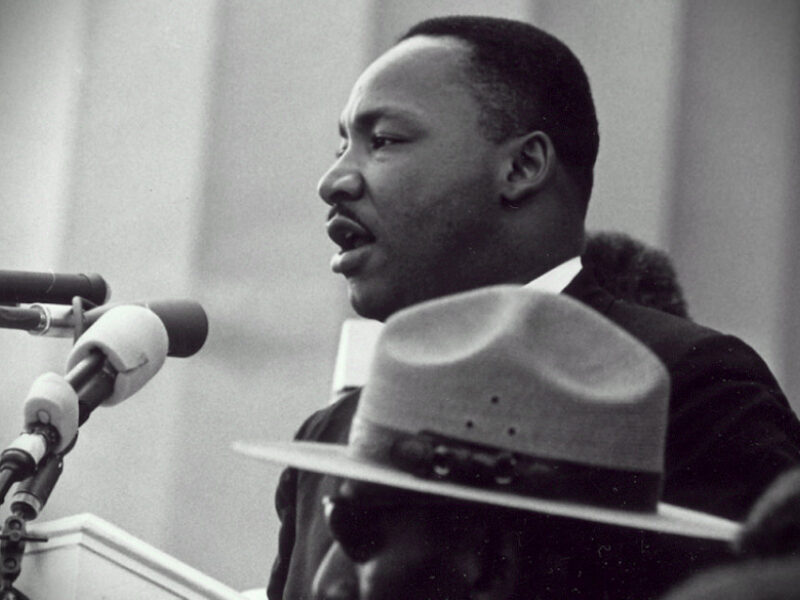
[EDITOR'S NOTE: We are re-posting this column (originally run Nov. 2nd) in honor of the Dr. Martin Luther King, whose life and work we celebrate today:}

“When machines and computers, profit motives and property rights are considered more important than people, the giant triplets of racism, militarism and economic exploitation are incapable of being conquered.”

– Dr. Martin Luther King,
from a speech delivered in 1967

by Mark Neuman

Contemplating the Giant Triplets
I am embarrassed to admit that, at age nine, I knew more about Forrest Tucker and Larry Storch and a TV situation comedy called “F Troop” than I did about the Rev. Dr. Martin Luther King, Jr.

I know this because I was watching a syndicated repeat of that silly show on the afternoon of April 4, 1968, when a news bulletin cut into regular programming to announce that Dr. King had been shot and killed earlier that day.

I did not know who he was.

I quickly got to know, in part, on the strength of my third and fourth grade teachers at Holy Rosary Elementary School in West Seattle, and then I never forgot.

Our recent handful of years
With an over half-trillion dollar burden set firmly on the backs of Americans not yet born, the powers-that-be recently bailed out the powerful who failed us.

And some number of millions of everyday Americans participated as well, in the pursuit of a piece of the glittering illusion: unbelievably rapidly appreciating equity.

Any number of common desk working brokers and agents just “did what the boss told us” to earn fast, fat commissions.

Regulators, overseers are somewhat difficult to blame. They, too, like the profits, were largely imaginary, nonexistent. Those who existed sat by, quite silent.

Today, a Senator from Illinois engenders, through no fault of his own, racist sentiments from various pockets all about our country.

And this is seven score and three years after the end of the Civil War.

And meanwhile another chunk of trillion has been thrown at a conflagration, a quagmire, in the Middle East that, inarguably, Dr. King would have opposed.

A great speech
And so I bring to you today words earnestly delivered by Dr. King, less than a year before he died. Officially it is titled: "Why I Am Opposed to the War in Vietnam."

It could quite well be subtitled: “The Giant Triplets Speech.”

It could also be called: “Please Don’t Make Our Country Look Like This in the First Decade of the 21st Century.”

If only all we Americans had recited or read, daily, his powerful words, spoken forty-one years ago:

“When machines and computers, profit motives and property rights are considered more important than people, the giant triplets of racism, militarism and economic exploitation are incapable of being conquered.”

In our modest blog offices it was suggested: Should we post and highlight this speech two days before Election Day?

We “Woodwarded and Bernsteined and Bradleed” this about. Would some be offended? Might some misunderstand?

Perhaps some will.

Some always do.

Any complaints? Send them to me.

Any credit or compliments? They go to Dr. King.

Here is a recording of, in my opinion, a stunning and timeless speech from the greatest and most courageous leader of my lifetime.

YouTube Preview Image

When you hear Dr. King’s words, spoken less than a year before he passed, does your heart beat fast?

I should expect and hope it would.

Perhaps your eyes water at certain points.

You’re in good company if they do, I assure.

Never heard this speech before? You are not to blame. We live in a “forget the past” society. Additionally, Dr. King’s other stunning and courageous works, including “Letter from Birmingham Jail,” happen to overshadow his own genius, literary and oratory greatness and prescience displayed at other times in his life.

Does the speech seem familiar? Please give it a listen again, in the relative stillness of this, the day most often set aside for meaningful thought, then send a note to that Social Studies teacher from grade six, your History professor from college, your Speech Coach and thank her or him for the initial introduction.

Send the links to your nephew in the Navy, your sisters from the old sorority, your Aunt in Auburn or Alabama, your boss in Bellevue, your kid in college.

Move it along the internet line to your favorite State Rep or least favorite Congressman, the most ethical attorney you know, or maybe even the least trustworthy scumbag Wall Street suit you are glad you never met, or, perhaps, are sorry you ever did.

Print out Dr. King’s words (we’ll get that link to you soon), fold it up and send them along with warmth in your Holiday greetings later this Autumn.

And so, on this Contemplative Sunday Holiday
No matter for whom you wish to loft into office with the fuel of your ballot this Tuesday, I am sure we can all agree, today, on this Contemplative Sunday, the following goal: Let us all, now and in these crucial near years, stare down those Giant and Ugly Triplets and knock them off their high perch for good.

Thanks.

–Mark Neuman
mark@b-townblog.com

[EDITOR'S NOTE: Bob is an Englishman who lives in Burien who is in Washington, D.C. for the Inauguration of President Obama. Previously, we posted his eyewitness account of election night, and are proud to be offering his continuing reports from the field on this historic occasion. This is the first in a series of exclusive reports Bob will be sending us, so be sure to check back often.]

PREPARING FOR INAUGURATION DAY
Thursday, November 6th, 2008 was a calm day. It felt like the world had changed and the weather was nice to go with it. After picking up the Seattle Times and Seattle Post Intelligencer as souvenirs, it occurred to me that there was no reason why I couldn’t go to the “other” Washington to see the inauguration. Fortunately, I have friends who live right across the river and are as enthusiastic as me about the whole thing.

A quick Google search for “Inauguration Day” led me to an official page which gave ticket details. So, I filled in the request form for tickets from Congressman Adam Smith and Senators Patty Murray and Maria Cantwell. I understood it was a long shot – my friend in Buffalo works for Senator Charles Schumer and they had so many requests that they decided to have a lottery for their tickets. It didn’t matter though. Getting a ticket was a bonus, because I was going anyway. I was going to stand on the mall with millions of others just to be there and witness history.

“I HAVE SOME GOOD NEWS FOR YOU…”
Monday, January 5th, 2009 was an ordinary day. That is, until 11:08 am when I got a phone call from a lady who said she worked for Congressman Adam Smith. She asked me if I’d made plans to go to the inauguration.

“Yes”, I said, “I’ll be there standing on the Mall with millions of others.”

“I have some good news for you”, she replied. “Someone canceled and you are next on the list for tickets.”

Once I’d emerged from a state of disbelief I did what she asked me to do, which was to send her proof of my flight arrangement. A few minutes later I had written confirmation of my tickets. My friends were as amazed as I was.

PLANNING THE TRIP
For many weeks now, we’ve been keeping a close eye on the Washington Post Inauguration Watch page and making sure we’ll make the most of the event.

Today, Sunday, January 18th, I’ll stand for many hours to secure a good place near the Lincoln Memorial for the opening ceremony.

[EDITOR'S NOTE: Bob called in around 9:40am Sunday morning to report he was indeed on the Mall, at the Lincoln Memorial with approximately "500,000 others," bundled up for the 35-degree cold and positioning himself to watch today's "We Are One" concert which features Bruce Springsteen, U2, Beyonce and several other big-name acts.]

On Monday, January 19th I’ll go to the Rayburn office building and pick up our tickets. We don’t know where we’ll be for certain, but it seems likely that we’ll be in the Silver Ticket section behind the reflecting pool:

On Tuesday, January 20th, we’ll either go to our seats or, more realistically, walk about six miles to the Silver ticket standing area at a horribly unsociable hour. The goal will be to try to position ourselves near the center so we can see the Capitol Building and keep one eye on the jumbotron to our right. We will, of course, be freezing, but thanks to that great Seattle company REI it may not be so bad.

We’ll then watch as Barack Obama becomes our 44th president.

I still can’t quite believe that, so I have to say it again:

We’ll watch Barack Obama become our 44th president!

Thank you Congressman Adam Smith for giving us tickets for the inauguration.

And thank you Barack Obama for inspiring us and millions of people in the United States and around the world.

Dec ’08
13
12:00 pm

Burien's Alexander Sasonoff grew up in "Rat City" and lived to write about it.

Recently we’ve been posting excerpts from longtime Burien resident, architect, artist and now author Alexander Sasonoff’s recently-published autobiography called “Growing Up in Rat City and Beyond.”

Also note that Mr. Sasonoff will be holding a book signing at the Elliott Bay Brewhouse & Pub on Saturday, Dec. 13th, from Noon to 5pm. The address is 255 SW 152nd Street in downtown Burien.

Here’s part three of “Growing Up in Rat City and Beyond” which can be purchased online for just $13.04 by clicking here (makes a great gift for anyone who lives or works in this area).

Part III: White Center Businesses and Amusements

Walter Coy owned and operated the only theatre in White Center called Coy’s Center Theatre. When he first started, he operated out of a storefront space next to Olberg’s Drug Store. Later he built a nice theatre on Roxbury St. between 16th and 17th S.W. Mr. Coy always said his profit margins were better selling popcorn than what he took in through the ticket window. On Saturdays there was a continuing serial that never seemed to end. The hero or heroine was always left in a near-death situation at the end of each episode that prompted one to come the next Saturday to see what happened.

Oren Artlip had a meat market and grocery store on the N.E. corner of 16th S.W. and 98th Street. He participated in the annual celebrations called White Center Days. Oren would provide a side of beef for roasting over a fire pit, which slowly turned on a spit. Later in the evening it would be carved and served to anyone willing to pay the plate price. With no money in pocket, I was just a drooling bystander.

I attended a small church on Holden Street where Oren taught a Sunday school class. He made us memorize all the books of the Bible and various verses. After I was discharged from the Army in 1951, I enrolled at the University of Washington to study architecture on the GI Bill. I received a stipend of $75 a month for expenses. It was never enough and Oren would let me charge my groceries at his store. At the end of the month when I received my check, I promptly paid him. It was very kind of him to help me through my five years of study in the School of Architecture.

All kinds of events took place during the White Center Days celebration. A boxing ring was set up and participants were encouraged to get into the ring blindfolded, one hand tied behind their back and the other hand was fitted with a 16-ounce boxing glove. It was usually a bunch of younger guys that were coaxed into the ring. When 8 or so volunteers were put together they entered the ring. At the sound of the bell everyone started flailing about trying to knock someone down. Once down, you had to get out of the ring. The last one standing won a monetary prize of around two dollars. One such event I remember well. A kid named Royce Natole was very short and ended up in the ring with some big guys. He was a feisty redhead with a face that was covered with large red freckles. The big guys kept swinging over the top of him. It got down to Royce and one of the big Ridley brothers. Royce couldn’t knock the big guy down and Ridley kept flailing the air over his head. He finally took the thumb of his 16-ounce glove and raised his blindfold and then popped Royce with a blow knocking Royce out of the ring.

Since my friends and I were always short of money, we devised a plan to sneak into the theatre. Located behind the building was an exit near the screen where heavy curtains blocked the light that might come in whenever the door was opened. We would knock on the exit door outside and some kid would sneak over and let us in. Crawling under the seats toward the lobby, we would pop up slowly in some empty seats somewhere in the middle of the theater. This went on for weeks until one day we got caught. We were all hauled up to the lobby, ostensibly to be reprimanded. To our surprise, the big brother of one of our friends was working as the manager. He just talked to us and then let us back into the movie but from then on, we found ways to earn enough money to pay our way.

While Oren’s Market was of good size, the surrounding neighborhoods were dotted with Mom and Pop grocery stores. I can think of about eight within a six-block radius of our home. There were no big superstores like we have today so all weekday shopping was done at the store closest to home, which in our case was Martha’s Grocery store. Saturdays, however, were reserved for a trip downtown to the Pike Place Market. Years later, the biggest store I’d ever seen was built by Safeway on the corner of 16th and Roxbury. It was the talk of the town for it was the first supermarket with grocery carts and checkout stands and for all of us who only knew the Mom and Pop stores, miles of shelves filled with every food product imaginable. It was new and very special.

There were no television sets or portable phones in those days so we would listen to our favorite radio programs in the evenings. They came one after another over the span of two or three hours—Terry and the Pirates, Little Orphan Annie, The Shadow, The Green Hornet, Popeye, The Lone Ranger and many others. It was easy to be so entertained. The wonderful thing about these programs is you had to use your imagination—unlike today where everything is visual. However one program my father wouldn’t allow us to listen to was Gang Busters. He was opposed to violence of any kind.

At the gas station located just around the corner from our house, a big event to watch was the arrival of the Gilmore gas tanker. The giant truck was highly polished and elaborately decorated with all kinds of banners and flags and pictures of lions. It was like watching the circus roll into town. The driver would employ a great deal of drama as he set out to entertain the crowd of young boys that would gather to watch. He would drag out the hoses and proceed to fill the underground tanks as we kids ran up to touch the truck and marvel at all the colorful banners.

The pumps that were used to dispense gas had a glass cylinder with measurements marking the number of gallons set on top of a metal one and gas was pumped by hand up into this glass container so that one could see how much gas he was about to purchase. This had to be done by the mechanic on duty or by one of the ladies working in the grocery store. When the proper measure of fuel appeared, it then flowed by gravity through a hose inserted into your tank or container. The hose formed a loop so when it was put back into the holder, there was always some gas left in the loop of the hose. The pumps were locked up at night, with some gas always left in that loop. This excess fuel caused a near disaster, as I will explain later in my story.

You can own your very own full copy of “Growing Up in Rat City and Beyond” by clicking here and ordering online today – it’s a great read, and it makes for a great gift!

Also, if you’re a local history buff, have you considered joining the Highline Historical Society? We’re members, and we encourage all our Readers to join this great non-profit today!

View Larger Map

Nov ’08
23
2:00 pm

The Highline Historical Society will hold its annual meeting on Sunday, Nov. 23rd at 2pm at the SeaTac City Hall, which is located at 4800 South 188th Street (see map below).

This meeting will also feature an encore showing of the Ken Slusher Documentary The Seike Garden: An American Story.” This 27-minute film tells the story of the Seike family and their beautiful Seike Japanese Gardens that were moved by the cities of Burien and SeaTac to make way for the 3rd runway at SeaTac International Airport.

It chronicles the history of the garden, cooperative efforts by local governments, nonprofits, and citizens to save the garden, and the physical challenge of relocating and replicating a 45 year-old living work of art. It also highlights the seminal roles that immigrant families have played in building the Highline community, a story that has been repeated in thousands of communities across America.

The film tells the (literally) moving story of the community effort to save this living gem. Using personal interviews and images drawn from family photos, Super-8 footage of original garden construction, and more recent still and motion photography, the film details the fascinating array of social, financial, and logistical hurdles involved in such projects.

A question and answer session with the filmmaker and one of the project managers involved with relocating the garden will follow the premiere.

Admission and parking are free.

View Larger Map

Alexander Sasonoff grew up in "Rat City" and lived to write about it.

by Scott Schaefer

Alexander Sasonoff is a longtime Burien resident whose acronym could easily be “AAA” – Architect, Artist and now…Author.

Just don’t call him if your car breaks down (although he could probably fix that too…).

Sasonoff, an accomplished local architect, grew up in neighboring White Center, and has just released an autobiographical book called “Growing Up in Rat City and Beyond” which he has generously allowed us to post exclusive excerpts from right here on the White Center Blog.

Sasonoff’s book takes readers on a gritty, often humorous journey from his earliest days in “Rat City,” starting when his Russian immigrant family moved here in 1936, through his childhood growing up in a tough neighborhood, playing in swamps, hanging out with boxers, getting fresh milk for 10-cents a jug from “Frenchie’s Farm” and much more.

Here’s part one of “Growing Up in Rat City and Beyond” which can be purchased online for just $13.04 by clicking here.

Part I • The Move to Rat City

The Move

As I sat in the front seat of the moving van clutching my cat, Reezhik, I had mixed feelings about moving to the house my parents had purchased near White Center. I was leaving all of my friends at F.A. McDonald Grade School as well as the other kids in my neighborhood. It was 1936 and the Boeing Aircraft Company was hiring workers. My Dad landed a job there.

The drums of war were starting their death rattle in Europe and the U.S. government ordered the construction of thirteen B17 bombers. These same thirteen bombers were flying into Hawaii when the Japanese attacked Pearl Harbor. It was a typical gray overcast day in Seattle. We were moving during a mid-school term so I would have to start all over again with new friends. Many good memories were being left behind. We lived across the street from lower Woodland Park. There were many picnics in the park and on the shores of Greenlake. Visits to the zoo will always be with me.

The driver of the moving van hated cats and threatened, if the cat got loose, he was going to throw him out the window. I tightened my grip on Reezhik. He made me sit as far from him as possible so I was squeezed up against the door panel with my brother, my Dad sat in the middle. I could not convey the threat to my cat but the cat must have sensed the hatred and did not move. Our dog, Spot, had already been safely transported to his new home.

It took about two hours in the lumbering moving van to get from Green Lake to our destination. We arrived without incident. The house was located on a double lot so there was plenty of space to play. Fruit trees abounded, there were apple, cherry, pear, plum and peach throughout the yard.

The oldest portion of the house used to be an office for a logging company that had cut all the timber in the area years before. It rested on a log foundation with the rest of the house added later. The newer portion had a very strange concrete foundation. I believe the basement was dug out after the house was constructed. The concrete was stepped and appeared to be about two feet thick. There were no sewers in the area and all of the streets were gravel. The sewage system was a simple cesspool that we all were warned to stay away from for fear of the wood planks collapsing.

Years later this area was sewered and after that came paved streets and sidewalks. My brother, Leon and I shared one bedroom while my two sisters, Vera and Ireda shared another. Later, we refurbished the attic creating two more bedrooms, so eventually each of us had our own room.

The house had only one bathroom. The water was heated by a coil of pipes in the wood burning furnace and kitchen stove. In the summertime there was never enough hot water generated by the kitchen stove. It was too warm to fire up the big furnace. Kettles of water were heated atop the kitchen stove to supplant the weekend baths. To save hot water, my brother and I used the same bath water.

This became a greater problem when our cousin moved in with us after being freed from a Japanese prison camp after the war. My Dad used to call me into the bathroom to wash his back. He sat in the tub while shaving. On one such occasion I asked him why he did not have any gray hair. I had noticed everyone getting on in years had gray hair. He answered me in Russian, “Ya vsegda moyu golavoo s holodnoi.” Translated, “I always wash my head with cold water.”

As the years passed and when I was in my twenties, washing my hair with cold water, I burst out laughing at the realization that he was telling me to keep a cool head. In that old house we finally had an electric hot water tank installed and there was much rejoicing.

Next week: part two of our continuing exclusive excerpts of “Growing Up in Rat City and Beyond”!

Courtesy BTB Reader Maureen Hoffman comes this interesting artifact from days gone by – an old price tag from a long-gone store called “Bell’s of Burien” which used to exist where the Burien Town Square is being built now:

Here’s what Maureen emailed:

Here’s a little bit of memorabilia I was amused by – my brother, a carpenter, was remodeling a local house recently and found this price tag from Bell’s of Burien, the original store (across from Mick Kelly’s) that was later Lamonts, (then Gottschalk’s) then sat empty for a long time before being torn down for Town Square.

I shopped there as a kid.

Oct ’08
11
12:00 pm

Burien’s historic Bison Creek Pizza has been remodeled, and will re-open this Saturday as Bison Creek Pizza & Pub!

The grand re-opening starts at Noon and goes until 2am.

One reason we’re all over this is that we love the history of the place. The building that houses Bison Creek once served as the “Burien Theater” and showed movies from 1957 and continued until the 1970s when the now-gone Lewis and Clark Theaters were built. According to some sources, the theater was popular for its Saturday triple features of low-budget monster movies, Jerry Lewis double features and the classic Beach Party series.

Great old newspaper ad for 'Big Bob's Pipe Dream.'

After the projector lights faded for the last time, it became home to a very unique restaurant called “Big Bob’s Pipe Dream” which had a large 1918 Wurlitzer organ that was moved from Seattle’s Coliseum Theatre (now Banana Republic). The Coliseum was owned by the Bullitt family, who owned KING-TV (disclosure: the Publisher/Editor of the B-Town Blog got his first media “gig” at KING-TV’s “Almost Live!” in 1985, and was proud to say he worked there when an elderly Dorothy Bullitt still ran the place). The story goes that one day the Bullitt sisters decided to sell the pipe organ, and “Bob,” who was a TV technician for KING-TV, was interested. The sisters offered it to him, but he thought he couldn’t afford it. Their reply was, “Would a dollar be too much?”

New booths have been installed and the old ceiling has been removed, exposing the original roof beams.

New booths have been installed and the old ceiling has been removed, exposing the original roof beams.

So this KING-TV tech guy buys a big ol’ pipe organ for a buck from the Bullitt sisters and moves it to Burien! The pipe organ allegedly ended up being sold to a man in Oregon, who used parts to build another one.

And now, the former-movie-theater-turned-pipe-organ-joint-turned-pizza-joint is starting anew as a remodeled pizza-pub-joint.

Bison Creek will now have “pub hours” on both Friday and Saturday nights – starting this Sat. Oct. 11th from 10pm-2am (21 and older only), with live music!

The new owners are inviting everyone to come down for the grand re-opening this Saturday starting at Noon until 2am, so get down there, show your support and tell ‘em the B-Town Blog sent ya!

Bison Creek is located at 630 SW 153rd Street (map below).

View Larger Map

Last week we were invited to a special presentation that revealed the new plans for the Highline Heritage Museum, which will be built at 819 SW 152nd Street in Olde Burien at Ambaum Blvd., where Karuna Yoga is now.

Highline Historical Society
Director Cyndi Upthegrove spoke about the new museum, along with Architect Tim Rohleder.

The museum will be housed in a brand new building with some rather innovative features, including:

  • Interesting “box-on-box” styled building (see pics below)
  • Innovative circulation system that utilizes natural cooling from underground
  • A large room suitable for Smithsonian traveling exhibits (making it the only Smithsonian-suitable museum in the area)
  • Unique ground floor windows with the faces of local pioneers (again, see photos below)

According to Cyndi, the museum will include some rather unusual (and ambitious) elements:

“The environmental system for the building will be geo-thermal. In this particular application we will be digging 25 pits to around 250 deep below the ground to a place where the temperature is a steady 57 degrees.  Tubes of liquid will circulate through these pits and a heat exchanger will heat and air condition the building using the temperature of the liquid in the tubes. For example, rather than bringing in 37 degree air and heating it to 68 degrees for the building in the winter, we will be using liquid that is already 57 degrees, not needing as much energy to bring the building to the required temp. For a slightly increased installation cost, we will install a system that will pay for itself in energy savings in 5-7 years, and perhaps sooner.

The upstairs gallery will not be developed with permanent exhibits.  Rather, it will be used for temporary and traveling exhibits.  The Society is working with the Smithsonian Institution to become a Smithsonian Affiliate Institution, making it possible to obtain artifacts and exhibits for long term exhibition. It is our intention to use Smithsonian Institution Traveling Exhibit Services (SITES) several times a year, as well as other nationally recognized traveling exhibit services to bring changing and interesting materials to the Highline community. The entire building has been designed with the security and environmental conditions in mind to house good traveling exhibits.”

Here are some photos provided by Rohleder Borges Architecture, the architects of the design:

Created with Admarket’s flickrSLiDR.

Hard to believe, but at one time the city of Burien had its very own mascot hydroplane, the aptly-named Miss Burien.

She never won a race, but for a scrappy boat on a relatively low budget, she was pretty competitive (kinda like Burien, no?), and certainly helped increase the profile of this here ‘burb.

Here are two recent videos of our namesake boat in action on Lake Washington:

httpv://www.youtube.com/watch?v=KQuwMMHsqe8

httpv://www.youtube.com/watch?v=cRGTJMCNfUs

The story of this much-loved and historic machine goes back to the late 1950s, and involves an organization called “Greater Burien, Inc.”, a precursor to the current-day Discover Burien (hey, how about a “Miss Discover Burien” hydro? Or “Misunderstood Burien“?), which funded its own hydroplane.

According to the Hydroplane and Raceboat Museum:

The original Miss Burien became kindling on Lake Coeur d’Alene during the running of the Diamond Cup in 1959. Like all unlimited hydroplane aficionados, owner Peter Woeck wanted to see the legacy of his boat continue. Woeck and his supporting cast of Greater Burien Inc. commissioned Ted Jones to build a larger, more competitive Miss Burien.

The Burien remained the flagship of every person who dreamed of running with the big boys. While she never had the depth of financial or equipment resources that the well-heeled teams possessed, she still put on a good show. In her first race, the 1960 Apple cup, she took third behind Miss Thriftway and Nitrogen Too, but out pointed Miss Bardahl. Chuck Hickling, a steady pilot, drove her in the Apple Cup and in a number of other races. Hickling later guided her to a second place finish at the Diamond Cup, winning the final heat but losing on total points. In 1961 Hickling and the Burien took second in the Seafair Trophy Race.

The Miss Burien never raced east of the Rockies, but she always put up a fight on the Western circuit. She campaigned as the Tempest in 1962 and ’63. She continued to be competitive, but never sustained the pressure to earn the winner’s circle. In 1964 she raced under three different names with results similar to her past. In 1965 her registered number was changed to U-50 and she competed as Savair’s Probe and was finally known simply as Probe. The boat was retired in 1980 and later donated to the Hydroplane and Raceboat Museum.

She was restored by the Museum in 1996 as the Miss South Park and finally completed her return to her roots by representing the ageless dream of every racing fan under her given name: Miss Burien, U-4.

Last we heard, the Miss Burien was still doing “vintage hydro” exhibition heats during races. We’re not sure where she’s stored these days, but we bet the good folks at the Hydroplane and Raceboat Museum know.

They’re located at 5917 South 196th Street in Kent; phone: 206.764.9453


View Larger Map

Fred Freitag, current owner of what was once the Three Tree Point Store, discovered a very interesting and historic hand-drawn map of the area in the basement of his house, which he has exclusively shared with the B-Town Blog.

It appears that the “Authoritative, accurate and comprehensive map of Three Tree Point and its immediate environs” was drawn by store owner Vi Sparks on Oct. 6, 1974, with “slight assistance” from Bill and Jeanne Sparks.

Some of our favorite elements of this map:

  • Some very cute drawings of ships, airplanes, cars, fish, birds, dogs, houses and even a donkey pulling a cart labeled “What is it??“!
  • Scale: 1 = an unknown number of feet!” scribbled at the bottom as a key
  • Humorous 1970s-era Smiley Face drawn in some blank space near the center

Click the image to see a larger and more detailed version:

Aug ’08
10
2:00 pm

The Highline Historical Society is sponsoring a very special presentation this Sunday, Aug. 10th, from 2pm–4pm at SeaTac City Hall (4800 S. 188th, SeaTac – map below) with Henry Friedman, author of the 1999 memoir “I’m No Hero: Journeys of a Holocaust Survivor.”

Some elements of the discussion will include:

  • Friedman will recount his adolescence and coming of age under the unspeakable horror of Nazism.
  • When the Nazis overran their home near the Polish-Ukrainian border, the Friedman family was saved by Ukrainian Christians who had worked for them at their family farm in the nearby village of Suchowola.
  • When the Russians liberated the family after 18 months in hiding, Henry, just short of 16, made his way with his family to a displaced persons camp in Austria.
  • In the camp, he discovered sex, money, and the intricacies of the black market.
  • Like many other Holocaust survivors, he found it difficult to examine the past.  However, his sense of obligation to bear witness eventually overcame his painful memories and his feelings of survivor-guilt.
  • In his “I’m No Hero” presentation, Mr. Friedman confronts with unblinking honesty the pain, shame, and bizarre comedy that were his passage to adulthood.

Audience:  Middle School through Adult, due to some mature content.

This should be a very interesting and informative event.

You can read Friedman’s book online here.

View Larger Map

May ’08
24
2:00 pm

TUKWILA – This Saturday, May 24th, from 2pm to 3:30pm at the Museum of Flight, you’re invited to meet and hear stories from the famed Tuskegee Airmen.

The Tuskegee Airmen were dedicated, determined young men who enlisted to become America’s first black military airmen, at a time when there were many people who thought that black men lacked intelligence, skill, courage and patriotism.

Prior to the Tuskegee Airmen, no U.S. military pilots had been black, so you can imagine the hurtles they faced.

They came from every section of the country, with large numbers coming from New York City, Washington, Los Angeles, Chicago, Philadelphia and Detroit. Each one possessed a strong personal desire to serve the United States of America at the best of his ability.

On Saturday, you can meet four actual surviving members of the 477th Bombardment Group out of Freeman Field, Indiana, including:

  • Leslie Williams
  • Fitzroy Newsum
  • Lt. Roger “Bill” Terry
  • Robert Maxwell

This historic program is free with Museum Admission.

The Museum of Flight is located at 9404 E Marginal Way South in Tukwila; the phone number is (206) 764-5720.


View Larger Map