Story & Photos by Michael Brunk
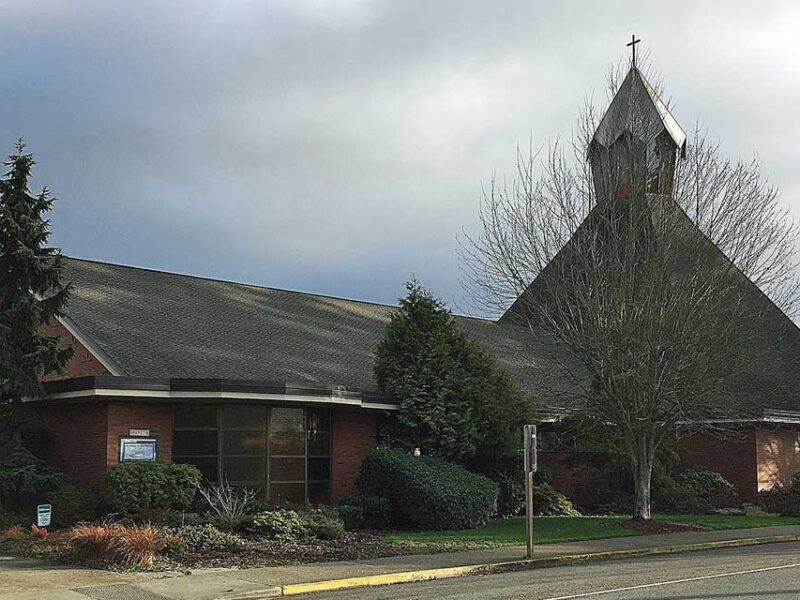
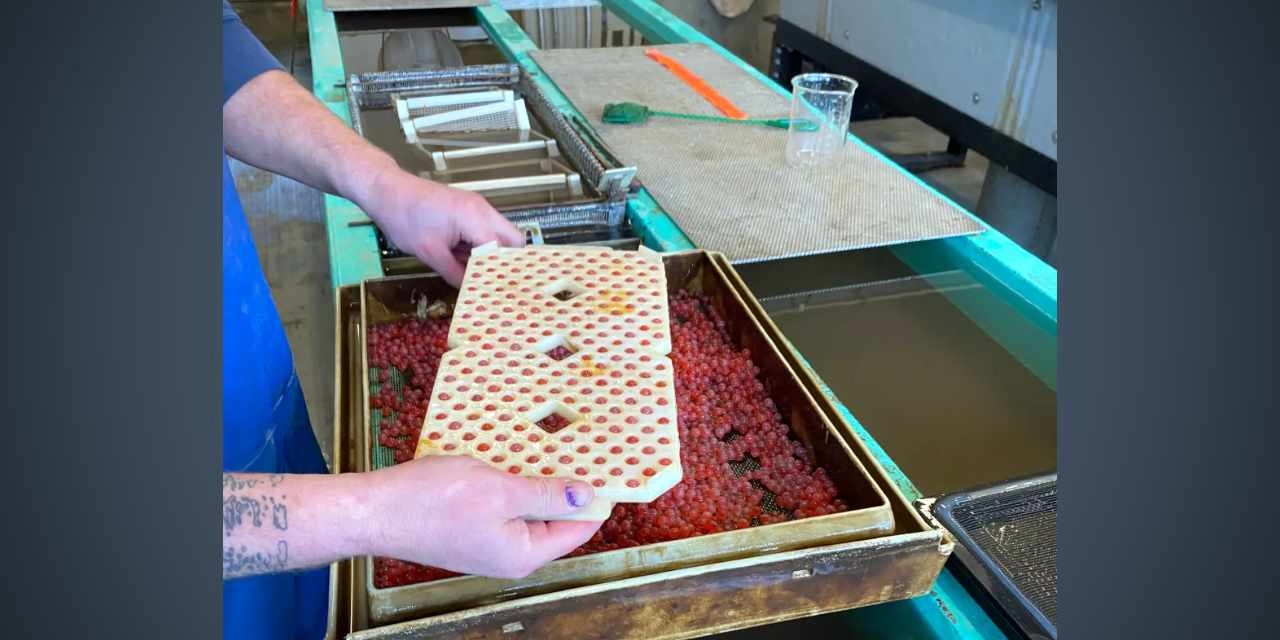
Tucked away in one corner of the Southwest Suburban Sewer District facility in Normandy Park is a small, unassuming building. It is here, just yards away from Miller Creek, that the Duwamish-Green Chapter of Trout Unlimited has their hatchery operation. On Saturday, January 23rd, members of Trout Unlimited and volunteers from across the community gathered here. Their purpose: to transport and release 110,000 young Coho Salmon fry into various creeks in the local area.
According to chapter member and local conservationist Andy Batcho, the Coho fry have been raised from eggs acquired from the Soos Creek Hatchery in early January. The fry are born with a yolk sac that provides nourishment at first, but soon the sac is consumed and it’s time for them to be released into the wild.
“It’s a balancing act,” says Dennis Clark, King County Steward of the Miller and Walker Creek basins. Despite the fact a wild Coho female will lay around 3,000 eggs, only 10% of those will hatch. This, combined with other factors, such as unexplained deaths of adult salmon before they can spawn, means that very few native fish are able to successfully reproduce.
Clark explained that hatchery operations are a useful piece of the overall strategy to bolster fish populations, but that it’s important that the newly planted fry not overwhelm the native fish. Timing and release location are two critical elements in ensuring that the hatchery-raised salmon are forced to compete and become healthy adult fish as a result.
In talking to the people at the hatchery and out in the field planting the young salmon, it is clear that this is an effort that attracts a broad swath of people from across the community – families with young children, retired engineers, doctors, local politicians, scientists, sportsmen and others. Despite the cold, gray weather, they come together with a desire to contribute something back to the environment.
By itself this volunteer-run effort is quite literally just a drop in the ocean, but combined with the hard work of many others in our region it adds to the incremental improvements in the overall health of the habitat in which we all live.
There are far worse ways to spend a Saturday morning.
Here’s a Photo Slideshow of the event:
Our friend Dennis Clark, Miller/Walker Creek Basin Steward for King County, alerts us that over 36 salmon have been spotted in Miller and Walker Creeks.
Here’s his report:
With the rains of fall comes another age-old marker of the turn of the seasons: the salmon are returning to Highline. Since October 10, at least three dozen coho salmon have returned to Miller and Walker Creeks. Coho have been reported multiple times in Normandy Park, Burien, and as far upstream as SeaTac. On Tuesday, Josh Feigin, an environmental specialist at the Port of Seattle, saw at least seven fish in Miller Creek on the airport property.
Some adult trout have been seen to pass upstream of this Miller Creek waterfall, which is about 5 feet high.
Remarkably, three of the fish made it past a substantial waterfall near S. 157th St. that usually prevents further upstream fish passage. The coho began their upstream migration from Puget Sound following the first fall rains and appear to come in spurts with each succeeding rainfall.
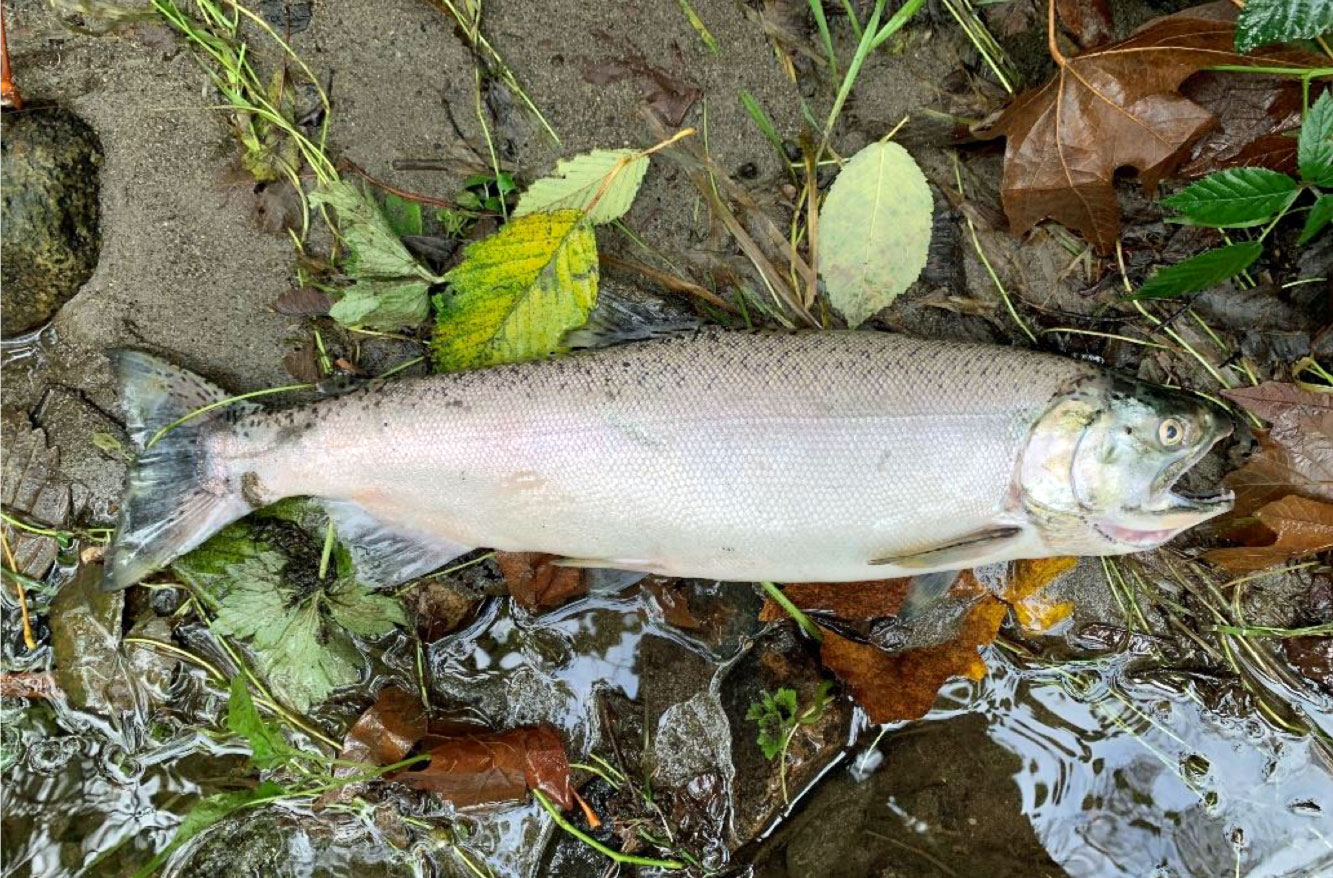
While these are fairly good numbers for early in the season, the news is not all good. Coho salmon on Miller Creek are suffering from what is termed “pre-spawn mortality.” Otherwise seemingly healthy fish are dying before they can spawn. Their deaths are preceded by bizarre swimming in which the fish literally throw themselves out of the water. I witnessed this disturbing behavior on Friday when a fish jumped over my boots before dying (more info here). It seems that as the rains gradually wash the pollutants that accumulated over the summer off the streets, fewer fish succumb to this phenomenon (and where do these pollutants go when “washed away”? Read more info here).
While the exact cause of pre-spawn mortality is unknown, it is likely linked to some combination of pollutants associated with modern industrial life. While research continues, Burien residents can avoid or reduce pollution that is known to harm salmon such as car wash soap (wash your car at a commercial car wash or while parked on the lawn), leaking oil (fix oil leaks promptly), and pesticides (limit use or choose alternatives safer for kids, pets, and fish).
Despite these problems, the presence and persistence of salmon that begin and end their epic lives right here in Burien is a compelling reminder of the amazing world we share. If you observe fish in the streams, please let Stream Steward Dennis Clark know by e-mail or at 206-296-1909.
Here’s a photo Dennis took Oct. 23rd of a male and female salmon at Miller Creek in Normandy Park:

Here are some photos courtesy Brett Fish showing the various stages of “pre-spawn mortality”:

A female coho has flung herself out of the stream and is flopping on the gravel bar.

Here the coho has come to her side and died in the shallows. Periodically her mouth would briefly gape open. She was visibly swollen with eggs that she will not have a chance to lay.

Determining whether a dead fish found suffered from pre-spawn mortality is not certain but if milt (sperm) or eggs are present, it is possible that is the cause. Brett cut this dead male open, revealing that the testes – the two white organs in the center of cavity – are still full of milt.
More information is available at Dennis’ excellent blog here.
| Oct ’09 |
| 17 |
| 12:00 pm |
Highline Community College’s Marine Science and Technology (MaST) Center is presenting a special seminar on “Jumbo” Squid with David Eric Hamm, NOAA Fisheries Research Scientist/Contractor, this Saturday, Oct. 17th at their location near the Redondo Beach Pier in Des Moines.
Rumor has it that there may even be a dissection taking place.
Here are the details:
WHAT: Special seminar on “Jumbo” (aka Humboldt) Squid with David Eric Hamm, NOAA Fisheries Research Scientist/Contractor
WHEN: Saturday, October 17 12:00 – 12:45
WHERE: Highline Community College MaST Center, located near the Redondo Beach Park in Des Moines
INFO: From their website:
They’re Big, They’re Here and They’re Squid Jumbo Squid as Harbingers of Ecosystem Change! Dosidicus gigas, the Humboldt or Jumbo squid is a voracious predator with a unique ecology.
The ongoing range expansion of this creature, coincident with changes in the California Current suggest that something larger is afoot.
Are these changes indication of global change? What will the impact be to our fisheries and the ecosystem of the West Coast? Come to the MaST Center, and find out.
Please join us to hear David Eric Hamm, NOAA Fisheries Research Scientist/Contractor
More info here.
Our friends at the UW-APL/PSSC Environmental & Marine Science Observatory at Seahurst Park have not only repaired their beach and underwater webcams, they’ve upgraded them to high definition.
This means that now you can watch HD footage not only of the beach, but from underwater as well!
Here are some pretty cool video clips ranging from time lapses that show the changing tides (fast-moving) passersby and sunsets, to clips of dogfish and more; as always, we feature these feeds on our Webcams page along with other local cams:
[display_podcast]
For video highlights from the Seahurst Beach Underwater camera, click here.
For an archive of Seahurst Beach HD clips, click here.
More info from their website:
The observatory is a collaboration between oceanographers and engineers at the University of Washington’s Applied Physics Laboratory and the Puget Sound Skills Center’s Environmental and Marine Science program. The Marine Science program has a wonderful shoreside facility located at the north end of Seahurst Park in Burien, Washington. To support the salmon hatchery located at the facility there are two saltwater intake pipes that run 850 feet from the building out to 25 feet of water. Those pipes provide an ideal means to run power and fiber optic ethernet cables for underwater instruments, providing a permanent, real-time, high bandwidth presence on the bottom of Puget Sound.
The observatory was installed through a combination of volunteer efforts and a science and engineering development project at APL-UW funded by the National Science Foundation. That project is working to install a cabled-to-shore profiling mooring at the MARS observatory in Monterey Bay, California. The installation at Seahurst provides a plug compatible observatory interface for testing that system in diver accessible depths right in our own backyard.
Data from the CTD is collected every 1.5 seconds. Time-lapse video frames are taken every 10 seconds. Daily time-lapse videos are archived. Full-rate video is captured and archived when motion is detected. For presentation on the front page of the web site a snapshot is taken once per minute and twenty seconds of full-rate (10 fps) video is taken every five minutes.
by Dennis Clark
Miller/Walker Creek Basin Steward
On Monday (Sept. 21st), a merry band of men who never lost their childhood sense of joy in playing in streams set off down Miller Creek in Burien and Normandy Park. Their grown up mission was to carefully assess and, where necessary, remove debris jams that block upstream salmon passage. With coho salmon due to return next month, now was the time to do this work.
Stream steward Dennis Clark, assisted by enthusiastic volunteers Andy Batcho, Jim Buchman, and Dave Evans, organized the project. Accompanying them was a Washington Department of Fish and Wildlife biologist, the aptly named Larry Fisher. The B-Town Blog’s own Michael Brunk, who thought he came along merely to take photos, also ended up helping to move the largest logs.
Click below to view his Photo Slideshow:
Salmon are persistent and agile fish and often can swim under, through, and over what appear to be complete blockages. However, in smaller streams such as Miller and Walker Creeks, some jams are complete blockages that would limit the ability of the fish to reach the upper parts of the stream where they would lay their eggs (spawn). At the same time, tree trunks and limbs in the stream provide an important role in creating pools where young salmon rear. Wood also provides shelter where young fish can hide from predators such as great blue herons. Consequently, the team carefully assessed each log/debris jam before deciding to take action. Larry provided the expertise and authority to determine which jams should be removed. Removal of jams in the stream – and most activities affecting the stream channel – require state approval. Based on their evaluation, the team disassembled two blockages. A third was too big for the equipment they had and they’ll return later this week to disassemble a part of that.
The debris jams on Miller Creek were on private property and the team thanks the various property owners who graciously granted property access.
This work complements ongoing efforts to improve streamside habitat, both by private property owners and through organized volunteer projects stretching from the Cove in Normandy Park to the restoration site on Miller Creek at S. 144th St. in Burien. October offers volunteer restoration opportunities on Miller and Walker Creeks on three Saturdays:
- Oct. 3rd
- Oct. 10th
- Oct. 17th
Learn more at the volunteer webpage here.
If you’re interested in volunteering on future stream blockage removals, contact Dennis at 206-296-1909, or via email: dennis.clark@kingcounty.gov.
You know summer is peaking when the salmon are biting so much that people are catching them from shorelines around the Burien area, including these folks seen at Three Tree Point on Sunday, Aug. 23rd:
“It’s crazy down there,” said a young man named Julio as he was waiting for a ride back up Maplewild. “Everyone’s catching their limit. Pink buzz bombs are working man – in fact, the fish are biting anything pink – even bubblegum!”
No word yet on which brand of bubblegum is best, but we’ll chew on it a while and let you know…
8/26 UPDATE: Wednesday afternoon, King County Sheriff’s deputies were checking for fishing licenses at Three Tree Point, so do NOT fish for salmon without one – you can buy them online here.
From BTB Contributing Photographer Gregory Rehmke comes these amazing photos taken Friday afternoon (Aug. 14th) of one of your Burien neighbors – a Bald Eagle – fishing in Lake Burien (click on each pic to view larger image):
| Jun ’09 |
| 20 |
| 12:00 pm |

Photo credit: OAR/NURP; Alaska Dept. of Fish and Game
Father’s Day is this coming weekend, and what better way to celebrate than by comparing dear ol’ Dad to a lingcod?
Highline Community College’s Marine Science and Technology Center (MaST), located in Redondo Beach (in Des Moines), is holding a special “Fatherhood Under the Sea” presentation from Noon to 12:45pm this Saturday, June 20th, and it’s FREE.
Here are the details:
WHAT: “Fatherhood Under the Sea” – learn why lingcods make such great fathers from Edmonds Underwater Park volunteers Ken Collins and Kirby Johnson during this special Father’s Day weekend presentation.
WHEN: Saturday, June 20th from Noon to 12:45pm
WHERE: Highline Community College’s Marine Science and Technology Center (MaST), located at 28203 Redondo Beach Drive South in Des Moines
COST: FREE
INFO: http://mast.highline.edu
Skipper’s Seafood & Chowder, located at 901 SW 148th Street in Burien at Ambaum (map below), appears to have floundered and may be sleeping with da fishes, with this eviction notice posted on its locked doors:

The notice was originally posted by King County Sheriff’s officers on April 3rd, but we only learned about it from a BTB Reader last week.
Currently, the building sits empty, with doors locked and the inside still full of typical restaurant equipment.
UPDATE 5/5/09: Sgt. John Urquhart told us Tuesday morning (5/5) that the owner owes back-rent of $48,000:
“I have been able to determine the eviction involves back-rent totaling about $48,000, plus attorney fees, according to documents filed with the court.”
Also our astute Facebook friend Brian Dirks updated us that Skippers has retained GVA Kidder Mathews to coordinate the disposition of all leasehold and business interests acquired by Skippers and to market and solicit Buyers for the 3,300 square foot restaurant on the nearly-25,000 s.f. property (for more info, or if you want to put a bid on it, click here – yes, you can actually bid through the skippersforsale.com website!).
Sgt. John Urquhart of King County Sheriff’s didn’t have much more info, offering this statement via email:
There really is no information the Sheriff’s Office has. We were merely operating on a court order.
As with all evictions, the Superior Court of King County orders us to take control of a premise and make sure whoever is occupying that premise packs up their belongs and leaves. Then we turn the premise over to the property owners.
With residential property there can be a number of reasons why the landlord got the eviction notice, including not paying the rent, operating a nuisance, drug activity……whatever.
However with a business property the reason is most likely they didn’t pay their rent. But we have no way of knowing and don’t really care, since we do 4,500 to 5,000 evictions of one sort or another every year.
The Skipper’s chain of restaurants filed for bankruptcy in December of 2007, after owing creditors $6.7 million, approximately $2 million of which was to the Internal Revenue Service.
Twenty-one of the outlets were then purchased by individual owners, including this one in Burien.
If any Readers know more information about this Skipper’s, please email us or leave a Comment below.
View Larger Map
Last Saturday, the population of Burien grew by 42,500.
You could be forgiven for missing your new neighbors because they’re only about an inch and a half long. They’re also covered in scales and like to eat bugs, so you may not have a lot in common with them. These new residents of Burien are coho salmon fry:

Basin Steward Dennis Clark and Normandy Park’s new city councilmember Marion Yoshino pour nearly 7,000 new Burien residents (aka Coho Fry) into Miller Creek where First Ave. South crosses it.
For the last six weeks, the salmon fry been raised by the volunteer group Trout Unlimited in a small hatchery on the grounds of the Southwest Suburban Sewer District plant in Normandy Park. The group received the coho as “eyed eggs” from the Washington Department of Fish and Wildlife. At the hatchery, a small building next to Miller Creek, the eggs and fry were incubated in trays constantly bathed in clean well water.

Trout Unlimited volunteers line up with buckets and coolers to collect their salmon fry for the run up the watershed to the outplanting locations.
On Saturday morning (Jan. 17th), 15 volunteers used buckets and ice chests to carry the fish to 15 sites along Miller and Walker Creeks in Burien and Normandy Park. Another 25,500 fish were released in Normandy Park.
Upon release, the coho have to fend for themselves amongst wild salmon fry. All the fry have to learn to survive the challenges of high stream flows and polluted stormwater, avoid predators such as great blue herons, and find enough food (insects – yum!). A smart, strong, and lucky few will survive a year living in our streams before heading down to Puget Sound. Even fewer will survive another 2-3 years in Puget Sound and the Pacific Ocean. In 2012 and 2013, a tiny fraction of the 42,500 fry released today in Burien will have survived incredible odds and will struggle to swim back up Miller and Walker Creeks. Back in fresh water, they’ll be looking for a bit of gravel and a mate to spawn with (our Pacific Northwest “circle of life” can match the Lion King’s any day!)
To help ensure the fish have healthier streams to return to, there will be a variety of restoration projects where you can volunteer this year – and as always, The B-Town Blog will list the opportunities well in advance!
To learn more about the streams and how they support our new neighbors, visit the Miller and Walker Creeks stewardship webpage.
[EDITOR'S NOTE: Extra special thanks to Miller/Walker Creek Basin Steward Dennis Clark for this post and photos!]
The Port of Seattle posted a pretty cool video of salmon migrating up Miller Creek on its website devoted to the third runway, because it relates to the restoration of Miller Creek:
“…part of the mitigation program for the construction of the soon-to-open third runway is the restoration of Miller Creek to a natural environment.
A major sign of success was videotaped for the first time since restoration was completed – spawning salmon returning to the creek:”
| Oct ’08 |
| 18 |
| 9:00 am |

Photos by Brett Fish
The Coho Salmon you see above was photographed at the “Fish House” in Miller Creek (ironically enough by longtime resident Brett Fish) and stands as a signal that yes indeed, the stewardship of both Miller and Walker Creeks is working!
But it’s not over – Sat. Oct. 18th your help is requested to work on the Miller Creek Renewal at S. 144th Way, from 9am to Noon.
- Do you care about a healthy environment for your children?
- Do you want to improve Highline for fish, wildlife and people?
- Do you like caring for trees that you’ll be able to watch grow year by year?
- Do you want to get rid of the stress of the work week by whacking non-native, invasive weeds?
- Do you want to meet some of your Highline neighbors?
- Do you want to make sure photos like the ones above can be taken again?
This will be the final maintenance work for the year at this site, where restoration began in October 2007. Come out to help weed, possibly plant a few final trees, and spread mulch.
Download the event flier that contains details and map (PDF file).
Here’s what you should bring:
- An eager attitude
- Sturdy shoes or boots
- Water bottle
- Gloves (if you have them)
- Gloves, tools, and snacks will be provided!
Location is South 144th Way, west of Des Moines Memorial Drive in Burien (map below).
For more info, email Dennis Clark, Basin Steward, or call him at 206-296-1909.

Join a project that’s been going strong in Normandy Park for four years – Stewardship of the Cove!
- Help improve Miller and Walker Creeks where they flow into Puget Sound
- Volunteers will help plant trees and shrubs or control invasive plants
- Work alongside the experienced hands of EarthCorps
- Lunch provided!
RSVP: Doug Osterman, 206-878-2578 or Tony Cassarino, 206-246-9941
Here’s a note of encouragement from Dennis Clark, King County Miller/Walker Creek Basin Steward:
The fish are returning to Miller and Walker Creeks!
Tony Cassarino observed a 4-5 pound coho salmon in Walker Creek next to Snake Road (13th Ave. SW) in Normandy Park on Tuesday Oct. 7th!
For the last eight years, the first fish have shown up in Miller or Walker Creeks during the first two weeks in October.
Welcome home, big guy!
First we reported on large six-gilled sharks swimming in Burien waters, and now we’ve discovered that there are also large jellyfish here as well – specifically “Lion’s Mane Jellyfish” (the world’s largest known species of jellyfish, and yes, they do sting) taped off Three Tree Point by area diver m4jwilliams:
The other morning I awoke to the sounds of shouting and loud engines. Looking out the window, I noticed a plethora of boats in front of the house.
Hmmm, I guess the salmon are running, says I (which is weird, ‘cuz everyone knows salmon can’t run).
Later in the morning, as we walked the dogs along the beach (and yes, we were packing plenty of plastic poop bags thankyouverymuch), fisherman of all sizes and shapes were wading into the water with those rubber, thigh-high topper boots. They looked pretty serious (or at the very least wealthy) with their giant waders, pocketed vests full of fishing paraphernalia, and brightly colored sharp hook thingies hanging from their hats.
And of course, those $500 fishing rods.
Always looking for a story, I realized this was prime fodder for “Underwood/Undercover’s” column; action in the Three Tree Point neighborhood is usually newsworthy (and easy to cover since I can just walk to it).
After in-depth questioning from U.U., the wading fisherman told me that the annual Three Tree Point fishing derby was today. In fact, it was…right now! The fish “weigh in” was at high Noon on the corner of Three Tree Point. This really piqued my interest because I have not fished in some time and was itching to get out the old pole (rod in fish lingo) again.
Only a few things needed to be done to accomplish my goal:
- A Fishing license needed to be procured post haste, as we just saw the Coast Guard speeding by. The fish cops were everywhere (I quickly checked my creel for a half-drunk can of Schmidt sport beer. Nope, all clear).
- Find someone to row my boat – er, I mean fish with me and take notes.
- Buy tackle at Big 5 Sporting Goods Store, however I had left the remainder of my cash on the table at 909 Coffee and Wine just this morning, so a trip to the cash machine was in order.
- Wash “Ol’ Rusty” the trusty (but rusty) ol’ rowboat and drag it out of the weeds now growing over and into the boat.
- Launch the boat (in other words, drag it down the hill and throw it over the bank.)
After I procured “the goods” from Big 5, I still needed to find someone to row the boat while I fished for “Walter” (code word for world’s biggest fish).
I found my lazy 18 year-old son in his usual spot – half asleep in front of the television. After much pleading on my part, he grunts something that sounded like: “maybe later.” But then again, I seem to have misplaced by Grunt-to-English Dictionary so I’m not really sure what the heck he said.
“Time is of the essence son, lets go, it will be a wonderful bonding experience!”
These words of encouragement fell on deaf ears. I think it was the utterance of the word “bonding” that sealed my doom.
Or the fact that I failed to translate my English to Grunt.
Seeing my curt dismissal from my son, my long-suffering husband then piped up and said he would be the “horse power” and row our 15-foot sturdy metal skiff (aka “Ol’ Rusty” which, come to think of it, isn’t so sturdy, and not so metallic anymore, and has probably rusted away some of its 15-foot length) while I fished.
After the usual bickering we launched the boat…well, sort of. Spouse rolled the rear-wheeled boat most of the way down the hill, and then pushed it over the bank. The loud crashing noise caused a nearby fisherman to look up, as if to say, “Not sporting old chap!” I noticed that his pipe fell out of his clenched teeth as he stared at us, mouth agape.
We caught a fish immediately with my pink florescent squid that I procured at Big 5. This marvelous little rubber-hooked-bouncer had always brought me good luck on my rare previous fishing forays. Our silver salmon was a good foot-and-a-half and put up quite a fight. We took a picture of the little fellow and let him go. Somehow I didn’t think my brave little fish would suffice for a “weigh in.” I couldn’t bear to keep him, and with my sketchy de-boning skills he would have been sushi by the time I finished with him.
My man-made horsepower rowed us around the point just in time for the weigh-in party. Little did we know that we were in for a treat. The great magician “Castro” (Who? Just in from Cuba perhaps??) performed a host of magic tricks, none of which involved rowing a rusty skiff or de-hooking an angry dogfish. However, the main event was the fish “weigh in,” and the prize awarded the biggest fish tale, I mean fish. The largest salmon weighed in at 17 pounds and had teeth to match. I spotted the usual assortment of dogfish and flounders but the salmon winner was a thing to behold.
And lo and behold – cna you guess which local neighborhood humor columnist won a prize?
Underwood/Undercover may have to take up a new hobby other than reporting the neighborhood happenings. I humbly accepted the “Best Sportsmanship” award, crediting my “man-made-horse-power” engine. Horsepower missed the award ceremonies, since he was just starting his long row back home in Ol’ Rusty, against the current (ha!).
As I walked home after the event, Horsepower loped up behind me. I proudly showed him our award and he held up his broken oar.
“I tied Ol’ Rusty up to a log on the beach,” he said.
The Three Tree Point Fishing Derby is held every year right before Labor Day, so come check it out. Wear your boots, and fish off the shore or procure a boat, hopefully with an engine.
It is my turn to row Ol’ Rusty next year, so I think we better start a few hours earlier.
Twenty-five years of living in Burien gives Humorist Shawn Underwood much fodder for her writings.
All of her stories are true, or at least have a grain of truth with no added embellishments.
Or something like that.
Read more of her humor at her website here.
We at the B-Town Blog give a hearty “seafood, deli and caterer” welcome to our newest advertiser, Alefaio’s Seafood Market & Polynesian Deli.
They are just a door or two down from the southeast corner of the intersection of SW 136th Street and Ambaum Blvd SW, a few blocks east of Seahurst Park, in north Burien.
Alefaio’s can be considered the lead ship on the bountiful waters of Burien’s top seafood markets.
David and Fina Alefaio have been in business for over three decades, and are soon to celebrate their second year in their current location.
Keep Alefaio’s in mind for their expert catering services – from family reunions, to corporate conferences to wedding receptions, they provide an authentic one-of-a-kind “Luau-style” catering experience.
Check the reader board inside for their carryout lunch and dinner menus and specials.
“We sell just about everything here,” says David.
No kidding. In addition to imported canned goods and a wide assortment of vegetables, here is a short list of what you can find:
- Indian Mackerel
- Spiny Gobyfish
- Farm raised Riverbank Fish from Viet Nam
- Calamari
- Cassava from Fiji
- Taro from several Pacific Ocean treasure troves
And don’t forget the octopus. You can buy it in frozen form at Alefaio’s.
“Our octopus comes from the waters between here and Hawaii,” David Alefaio says. “They come with all eight tentacles.”
He will be happy to coach you in the preparation of octopus and, for that matter, anything and everything his market offers.
“With octopus, boil it a little first,” he says. “Then sauté it with ginger, garlic, olive oil and green onions.”
Alefaio’s Seafood Market & Polynesian Deli (and catering) is open seven days a week, 9am to 8pm, and is located at (map below):
13612 Ambaum Blvd SW in Burien
(206) 938-8551
Play this MP3 file as you read this story:
[display_podcast]
Intrepid B-Town Blog Reporter/Sales & Promotions Diva Janet Grella had a random encounter last night with a TV Producer who was scouting the beach at Three Tree Point for a production he’s doing this weekend.
Turns out that the production is all about sharks.
That live in Puget Sound.
Off Burien.
Big, Six-Gill Sharks (these ain’t Dogfish) that grow up to 18 feet, as seen in this video:
The TV Producer, Vince Patton, who works for Oregon Public Broadcasting, explained the production via email:
The animal: The 6 Gill Shark. (Check Wikipedia for details. Their summary is accurate as I read it).
The Seattle Aquarium has an exhibit specifically on 6 Gill Sharks here.
Our show is “Oregon Field Guide” and we are shooting a story for OFG’s upcoming 20th anniversary season which begins in October. This story could run anytime between October and next spring.
The folks who sell Diving Tours with the Sharks on the boat you may see in the area are here.
The tours move around, depending on where they find the sharks hanging out. This year, it’s right near Des Moines. Dives happen at night. Yes, from 10pm to 5am. They have lots of lights set up on the shark cage where the divers go.
The 6 Gills have made the news in the Seattle area a few times since the late 90’s, but overall most of the public don’t know they’re here. They’re not aggressive to humans and there’s never been any human/shark incidents here.
So, next time you’re swimming in Puget Sound (ya right, at temps around 55 degrees! ha), and you hear a low, deep bass “da-duhm…” music sting, be sure to look closely, as you may see this friendly fella:
Courtesy our new Sales & Promotion Diva Janet Grella comes this interesting photo taken of the beach at Three Tree Point, with a distinctive red hue to the water.
Could this be red tide?

According to Wikipedia…
“Red tide” is a common name for a phenomenon known as an algal bloom, an event in which estuarine, marine, or fresh water algae accumulate rapidly in the water column, or “bloom”. These algae, more specifically phytoplankton, are microscopic, single-celled protists, plant-like organisms that can form dense, visible patches near the water’s surface. Certain species of phytoplanktonalgal bloom. contain photosynthetic pigments that vary in colour from green to brown to red, and when the algae are present in high concentrations, the water appears to be discoloured or murky, varying in colour from purple to almost pink, normally being red or green. Not all algal blooms are dense enough to cause water discolouration, and not all discoloured waters associated with algal blooms are red. Additionally, red tides are not typically associated with tidal movement of water, hence the preference among scientists to use the term
Some red tides are associated with the production of natural toxins, depletion of dissolved oxygen or other harmful impacts, and are generally described as harmful algal blooms. The most conspicuous effects of red tides are the associated wildlife mortalities among marine and coastal species of fish, birds, marine mammals and other organisms.
If there are any marine biologists out there who know more, please email us ASAP!
In the meantime, we suggest using common sense and not harvesting or eating any local shellfish until we know for sure.
| Jun ’08 |
| 16 |
| 9:30 am |
The brand spankin’ new Highline Community College Marine Science & Technology (MaST) Center opens Monday (June 16th) at 9:30am, with a special Dedication Ceremony featuring Congressman Adam Smith at 10am.
Festivities will go on all day until 7pm, and more info is available here (as a PDF file).
Located just four miles south of HCC’s campus at Redondo Beach and halfway between Seattle and Tacoma, the MaST Center is dedicated to expanding knowledge about the Puget Sound and the surrounding environment through teaching, outreach, and research.
The brand new, 2,500 square-foot facility, situated on a 260-foot pier over the Puget Sound, will offer public space, classroom, laboratories, and office and research areas.
With more than 2,000 gallons of flow-through saltwater tanks, holding more than 80 species of local marine life and easy access to a huge diversity of nearby habitats, and state-of-the-art equipment, the opportunity for research and education is almost limitless.
Walking on Three Tree Point, I ran into a group of seal-clad divers who were quite talkative due to the high from the surplus of oxygen they inhaled while diving.
I am a diver as well so I can attest to this glorious feeling.
After the usual pleasantries, the divers enlightened us on what fish roamed beneath the dark seas of Three Tree Point. One fish I remember in particular was said to swim upside down. I assume his swim bladder was on the fritz but then I am no expert on fish. I simply know what I like to eat and what I prefer to stay away from.
Aside from the vertically challenged fish, the really interesting tidbit from our local divers concerns the local garbage gossip.
Yes, you heard me correctly – we have a swim-through appliance store for those interested in purchasing a waterlogged Frigidaire or a barnacle-encrusted range.
The scuba divers claim they can identify which neighbor is dumping excess odds and ends into the water by the brand of appliances they swim by. Both divers said the dishwashers, dryers and washers make for excellent reef habitat for the fish.
According to our local divers, there are just enough appliances currently under water near the point to make for pleasant swim-through for our water-breathing friends. No further appliances are needed to improve the fish habitat.
So don’t get any ideas about dumping your old Maytag, because, according to the commercial – Maytags never break down!
According to The Seattle Times newspaper, the United States wins the award for the most garbage/debris picked up on its 10,000-mile stretch of beaches. 190,000 volunteers collected 390 pounds of trash per beach mile, and this is just the debris that we can see – wrappers, caps, straws, fishing line and, my personal favorite – the cigarette butt. Some smokers, unlike the rest of the civilized population, tend to drop their used “butts” regardless of their locations.
This is not a story about smoking so I will refrain from climbing on my horse of height.
The volunteers also included divers who scoured the water, collecting similar debris found on dry land. They also found items a bit more threatening to fish and man. Our friendly local divers said the Seattle fish move through the water blissfully unaware of the dangers of an abandoned trap (fish are not known for their high IQs), and enjoy the man-made reefs.
What fish wouldn’t want to make a nice home in a crustacean covered G.E. dishwasher?
Twenty-five years of living in Burien gives Shawn Underwood much fodder for her writings.
All of her stories are true, or at least have a grain of truth with no added embellishments.
Read more of her humor at her website here.
Shhhhh…don’t tell anyone, but we found an amazingly candid hidden camera video of one of your uglier neighbors in action:
[that's right...it's a Ratfish swimming around Three Tree Point. who'd you think we were talkin' 'bout?]